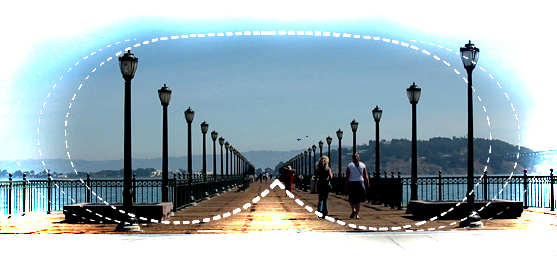
As
light travels in a straight line, our eyes like a camera, must
be pointed at the subject. The camera is very similar to the
eye and as such is the the only machine modeled on a sense organ.
However, unlike the camera, the eye takes two pictures
simultaneously, one in black and white and the other in colour.
Special cells in the retina, called rods register black and
white only - these are very sensitive to light detecting light
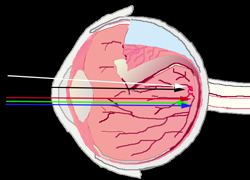
as low as 100- billionth of a watt. Other cells in the retina
called cones are affected by colour and and are concentrated
around the fovea, the area where the light falls when the eye
is focused. Where the optic nerve leaves the retina and sends
the information to the brain for processing, there is neither
cones nor rods and this causes a blind spot where no information
is recorded. |
|
Move over
image to view roll over image
|