|
Artist Journal - Hybridize - © Lloyd Godman - A super sustainable art project in progress
This is a very long term project, with unpredictable results - as an extension of the Classification work - the concept is to cross-pollinate some of my Bromeliad collection, germinate and then grow the seed on to maturity for 4 -5 years, observe what eventuates and then name the new hybrids after fossil fuel machines - this also becomes a link to the Plant Room
The Aesthetics of Bromeliads - a book in progress
Bromeliad Foliage
The primary function of pigments in plants is photosynthesis, which uses the green pigment chlorophyll along with several red and yellow pigments that help to capture as much light energy as possible.
Other functions of pigments in plants include attracting insects to flowers to encourage pollination.
Plant pigments include a variety of different kinds of molecule, including porphyrins, carotenoids, anthocyanins and betalains. All biological pigments selectively absorb certain wavelengths of light while reflecting others. The light that is absorbed may be used by the plant to power chemical reactions, while the reflected wavelengths of light determine the color the pigment will appear to the eye
The principal pigments responsible are:
- Chlorophyll is the primary pigment in plants; it is a chlorin that absorbs yellow and blue wavelengths of light while reflecting green. It is the presence and relative abundance of chlorophyll that gives plants their green color. All land plants and green algae possess two forms of this pigment: chlorophyll a and chlorophyll b. Kelps, diatoms, and other photosynthetic heterokonts contain chlorophyll c instead of b, while red algae possess only chlorophyll a. All chlorophylls serve as the primary means plants use to intercept light in order to fuel photosynthesis.[citation needed]
- Anthocyanins (literally "flower blue") are water-soluble flavonoid pigments that appear red to blue, according to pH. They occur in all tissues of higher plants, providing color in leaves, plant stem, roots, flowers, and fruits, though not always in sufficient quantities to be noticeable. Anthocyanins are most visible in the petals of flowers, where they may make up as much as 30% of the dry weight of the tissue. They are also responsible for the purple color seen on the underside of tropical shade plants such as Tradescantia zebrina; in these plants, the anthocyanin catches light that has passed through the leaf and reflects it back towards regions bearing chlorophyll, in order to maximize the use of available light
While some plant families may have a great genetic diversity between individual plants, species and genera, this may not be expressed in an obvious visual manner that is easily identified by the eye. However in this regard Bromeliads are exhibitionist, where genetic diversity is most often expressed in a highly visible manner, through leaf colour and shape. As one of the last plant families to evolve the genetic sequence can lead to a huge diversity of plants in nature and an even greater diversity when exploited by growers and hybridizers. Combined variations of pigmentation and trichmes in the foliage, which usually grows in a rosette, affords the most widely patterned and coloured of any plant family on the planet. So much so, that many people who first see these exotic plants with thick strap like leaves believe them to be "fantasy" plants designed in the imagination and made of plastic.
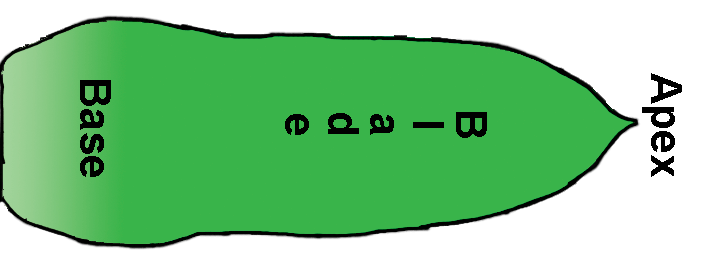
The foliage of plants, within the more than 3,000 species of Bromeliad family, (and the countless hybrids and cultivars) can take very different shapes, from narrow needle like leaf forms, leaves that taper from a wide base to a sharp point, to wide leaves with an almost square blunt tip. The leaves can be thin and delicate to thick and leather like. Through the cross section of leaf, they can be flat, or strongly curved, they can form symmetrically or irregularly, be very short to long and the leaf edge can vary from sharp spines to a smooth soft edge. The spines can not only vary in shape and spacing but also in colour which can often contrast dramatically with the leaf colour affording a visual accent.
These plants expression of anthocyanin pigments can be exquisite with a huge range of red, blue, or violet pigments possible. Likewise the range of greens in the chlorophyll pigments is also varied from light green to deep almost black green. Leaf colours range from almost black, maroon, bright red, pink through shades of green, to gold. But a more spectacular feature of many plants is the exotic combinations of pigments, where leaves have striking patterns. Varieties may have leaves with red, yellow, white and cream variations. Others may be spotted with purple, red, or cream, while others have different colours on the tops (adaxial) to the bottom (abaxial) of the leaf, stripes that run down the leaf length or across the leaf.
As mentioned, these colours are formed by pigmentations in the leaf, but as another dimension to the aesthetic of the Bromeliad leaf, tichomes can be invisible, or show as a thick white dusting, distinct silver bands, patterns or as in some Tillandsia even cover the entire plant in a silver fuzz. In some plants, trichome patterns can defer considerably from the upper side of the leaf to the top side. The trichome is not a pigment in the plant tissue, but a small cell on the surface that has the ability to uptake water and also reflect light.
In some plants, exposure to high light levels can enhance the saturation of these pigments, while in other plants high light levels can bleach the colour.
Different genera within the family can look quite different. Further to this leaf colour and shape can alter with differing exposure to sunlight. While light can intensify the colour, over exposure can bleach the pigments, and even burn the leaf. Darker situations can dull the colour.
Leaf pigmentation patterns can take many forms: On some plants these pigmentation patterns form through the entire thickness of the leaf and reveal a similar pattern top and bottom, while in other plants the top of the leaf can be completely different from the bottom. It should be remembered that these are simplified terms, definitions and examples and often plants combine a range of these colour expressions particularly in new hybrids.
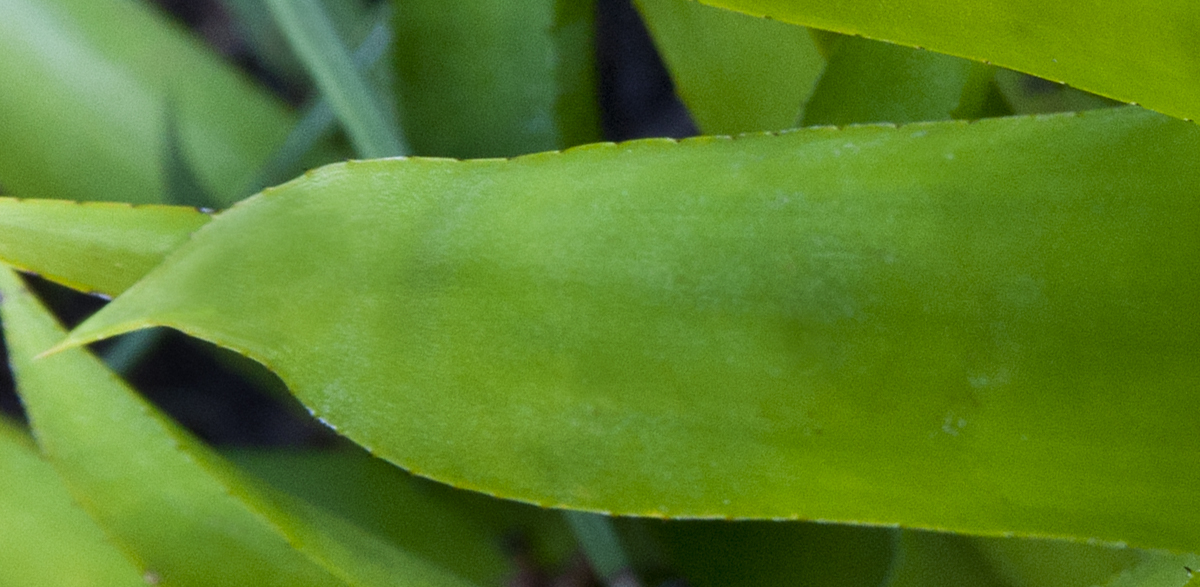
|
uniformis: this is the simplest pigmentation, here the leaf is a single colour, most often green |
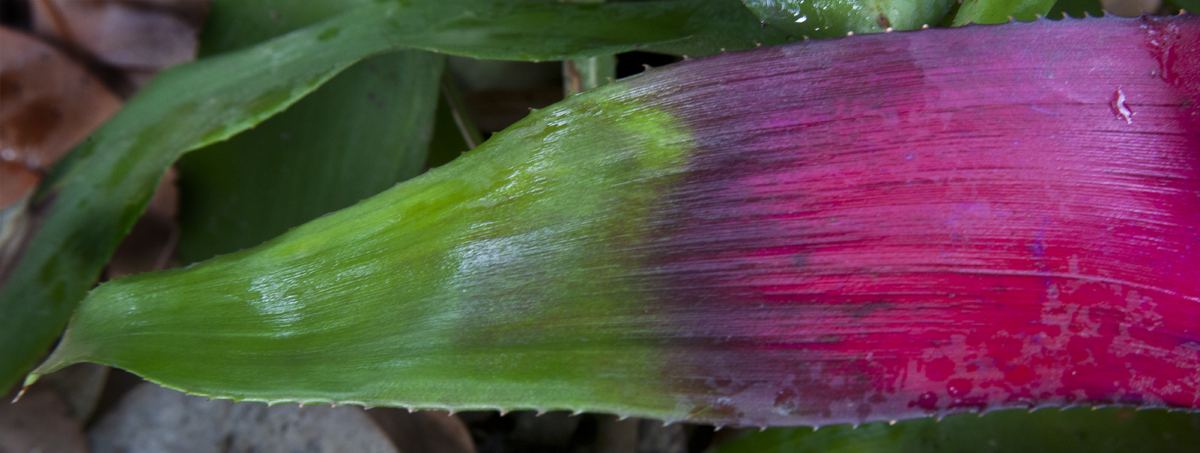
|
graduatus: where the colour of the leaf gradually shifts from one colour to another |
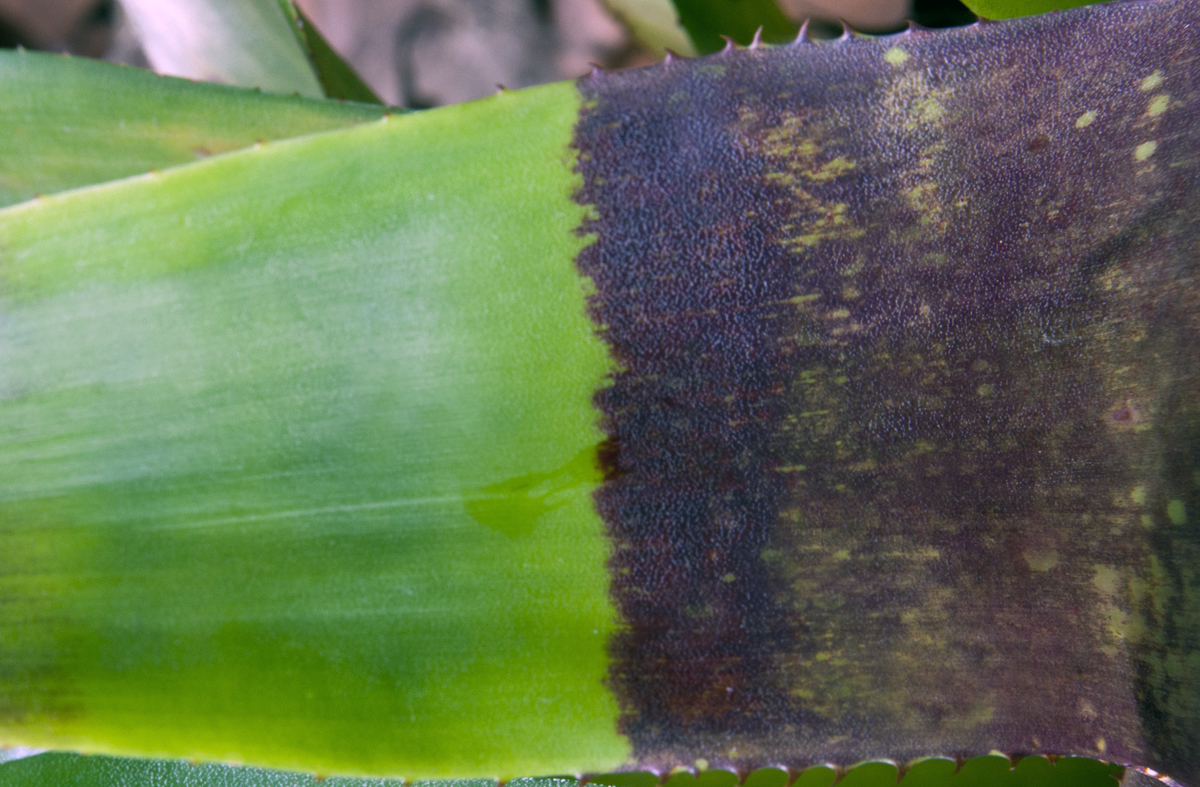
|
repens: Abrupt sudden, in some leaves the pigmentation abruptly changes colour as in a hard line |
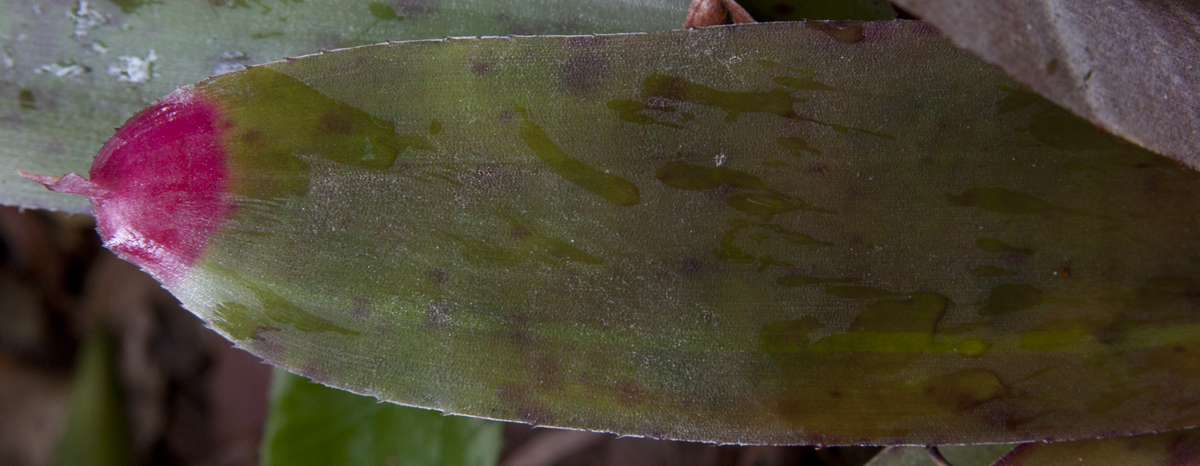
|
mucro: sharp point, edge, dagger point, here the very tip of the leaf is a different colour |
| |
pessum: to the ground, to the bottom, downward, the bottom or base of the leaf on the underside of the leaf. Because of the rosette shape of many plants this often not visible from above as it faces outwards
|
|
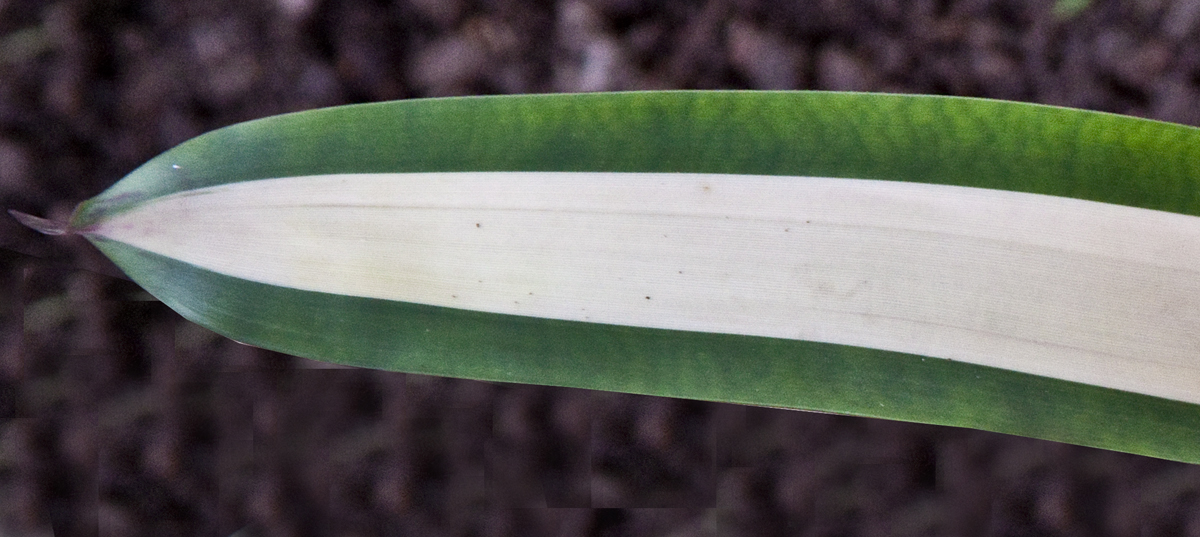
variegata: Irregularly colored or blotched; but in Bromeliaceae generally accepted as longitudinally striped. Variegated. The leaf edge is green and the middle area white or yellow. |
|
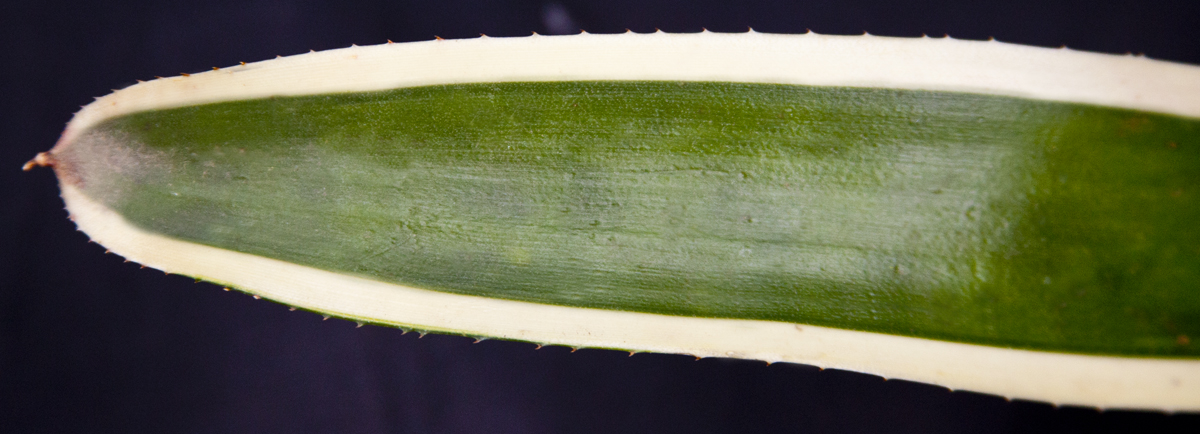
marginata: usually albo-marginata, meaning the white or lighter colour is at the edge of the leaf, while the central leaf zone remains solid green |
|
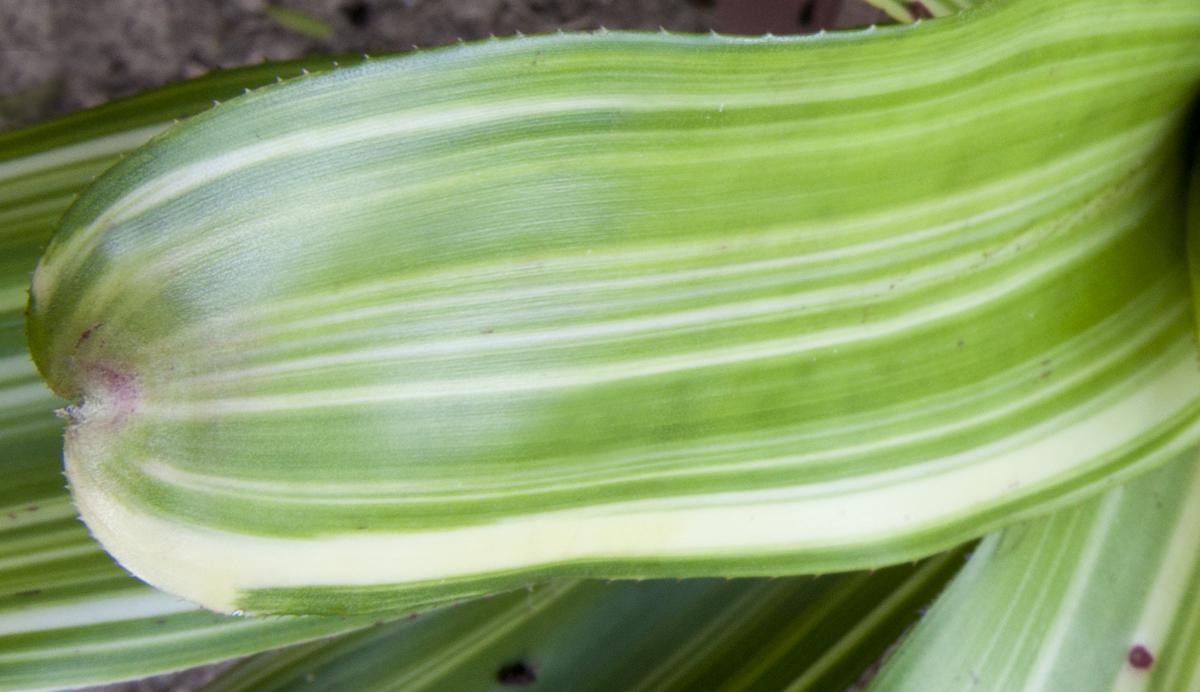
striata: A form of variegation - striped; marked with longitudinal lines, where the foliage is green overlaid with longitudinal white or yellow stripes of varying widths. |
|
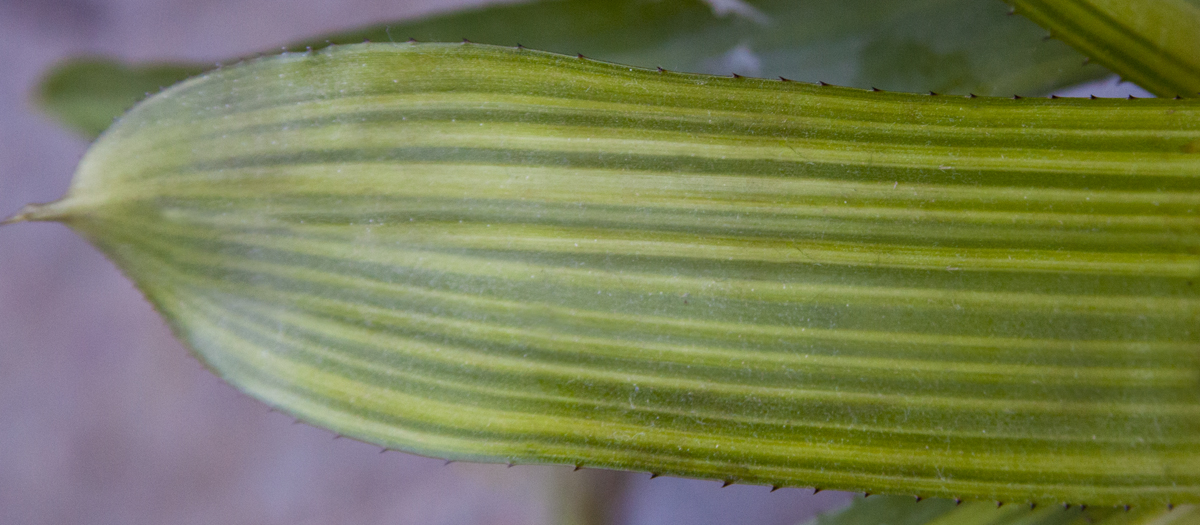
lineatum: lineata: With thin lines or stripes. |
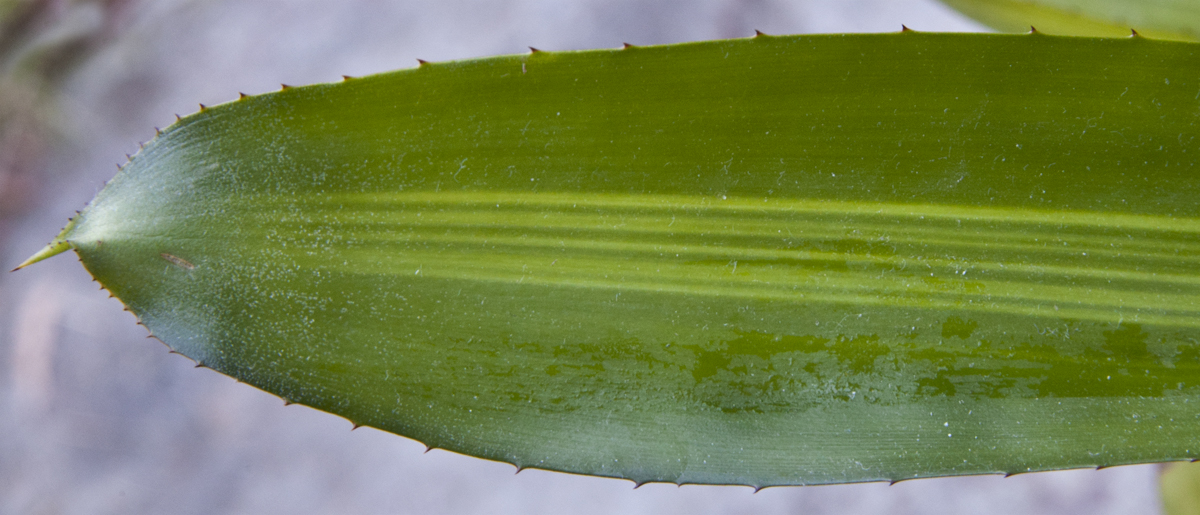
|
Medio-picta: medio-picta: a form of variegation where the center of the leaf is a whitish colour |
| |
paxianum: With green leaf margins and a single , broad white strip
|
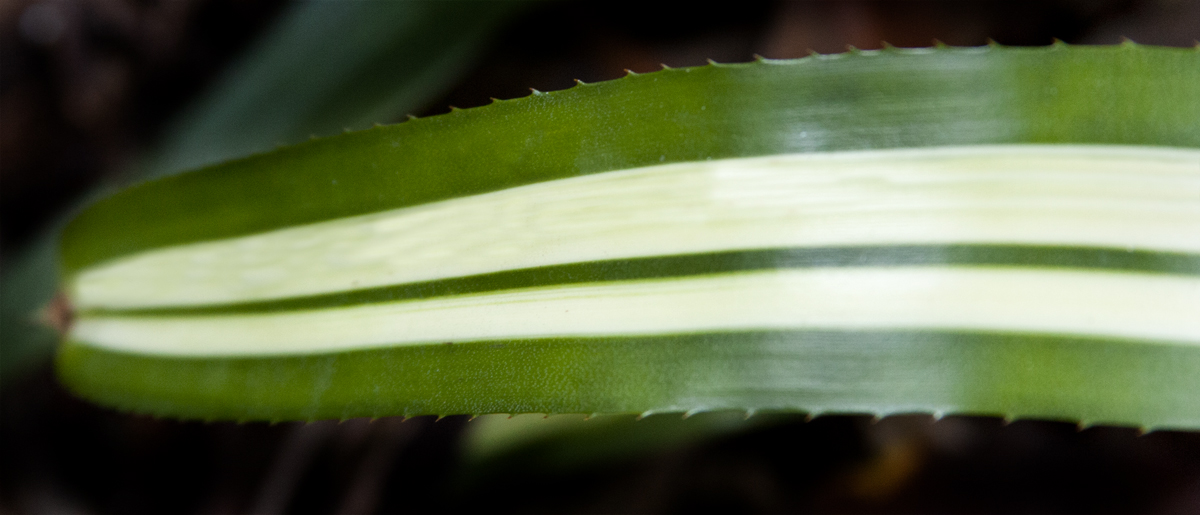
|
bivittatus: bivittatus: doubly striped lengthwise
|
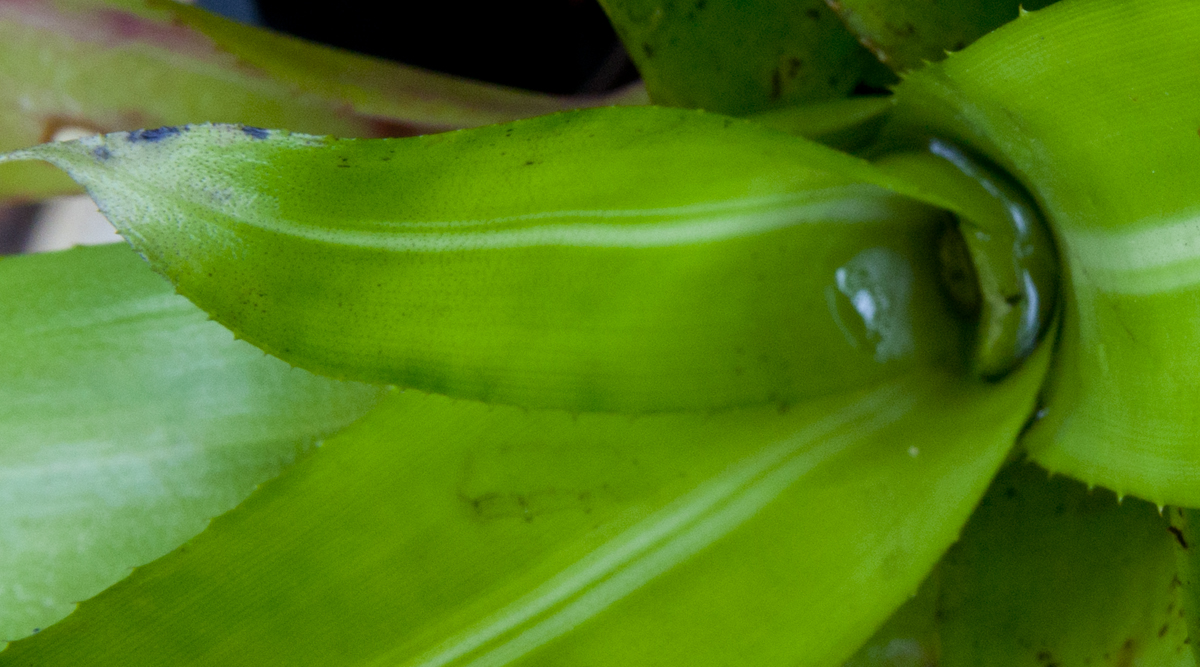
|
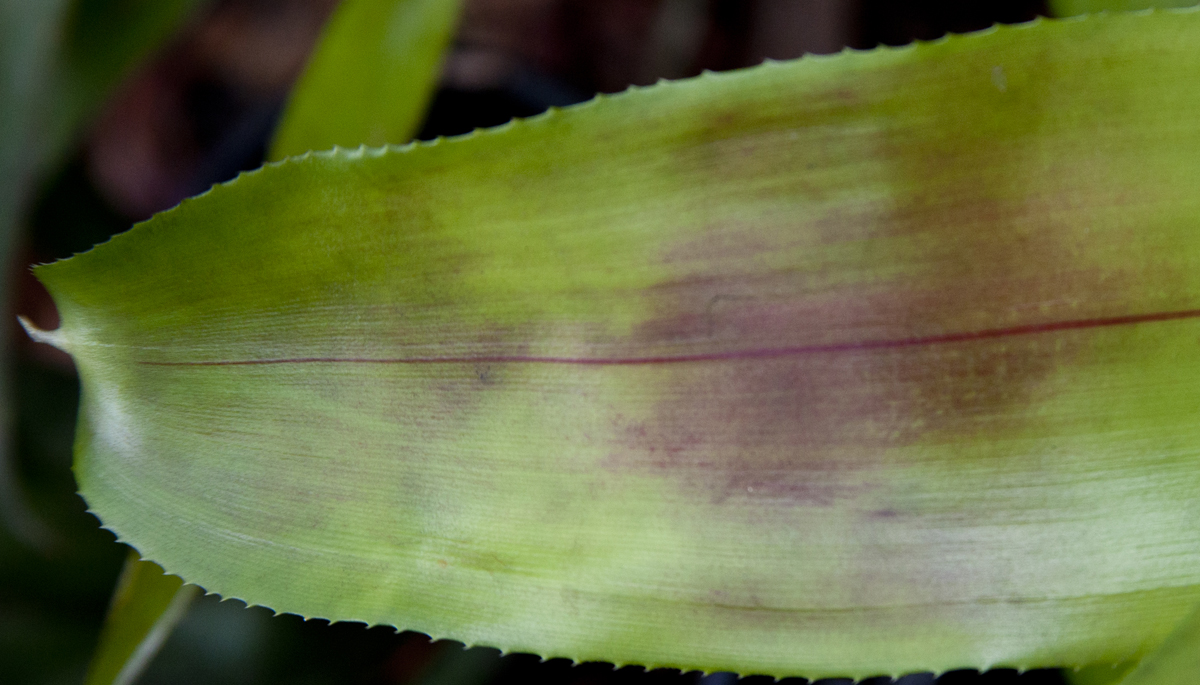
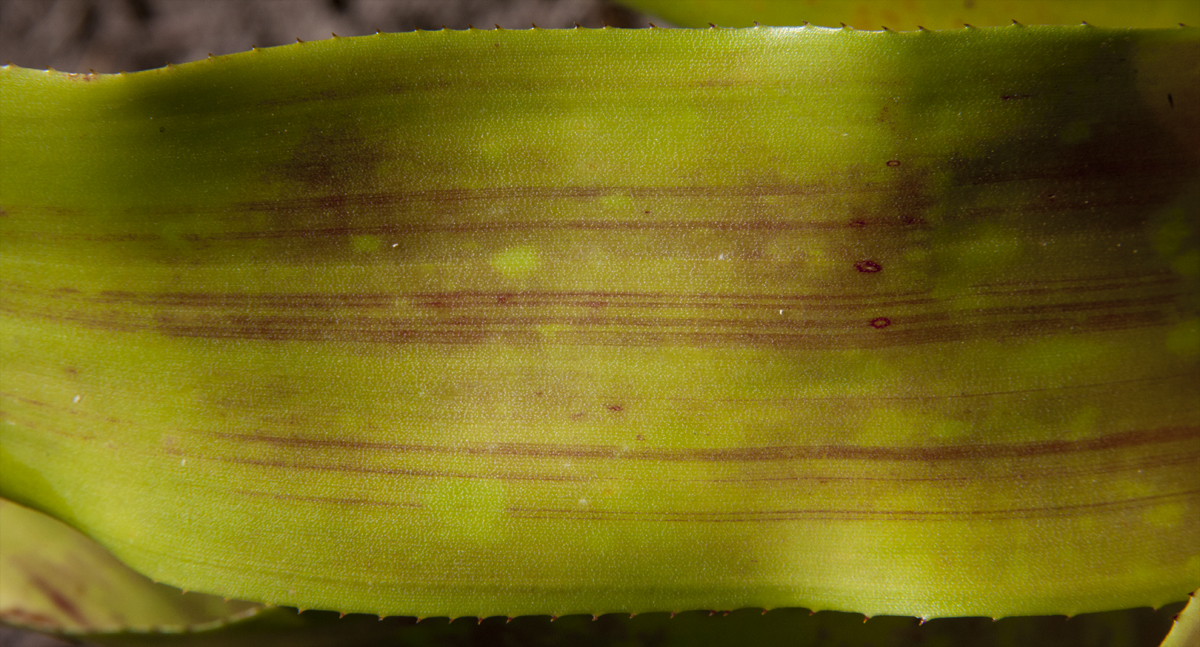
unum aciem tenuem - a single thin line |
|
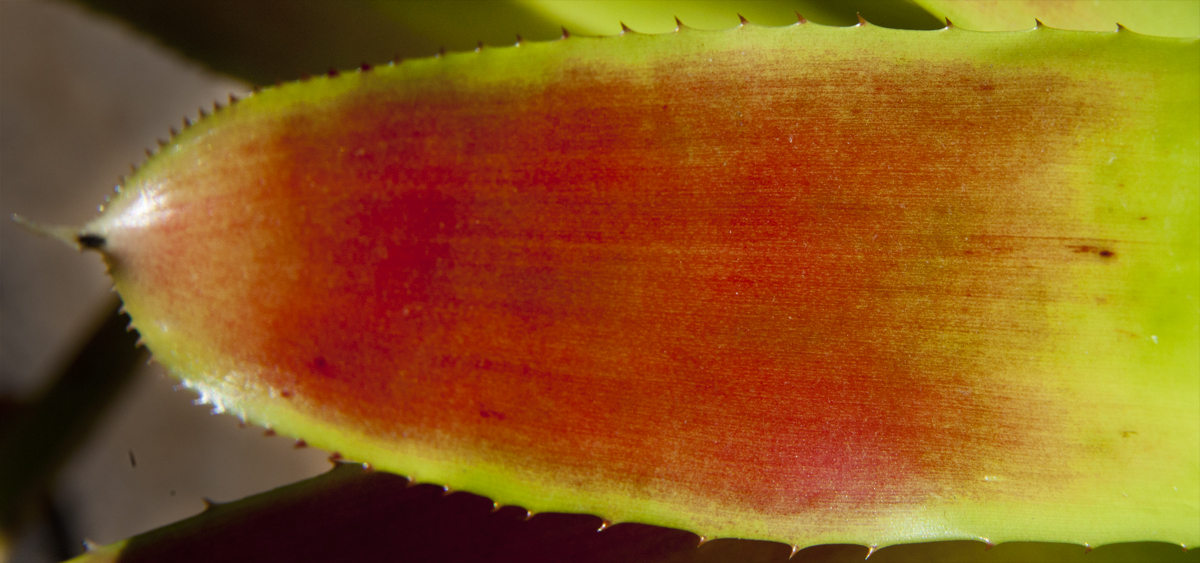
plagis vermiculus - red or crimsom stripes |
|
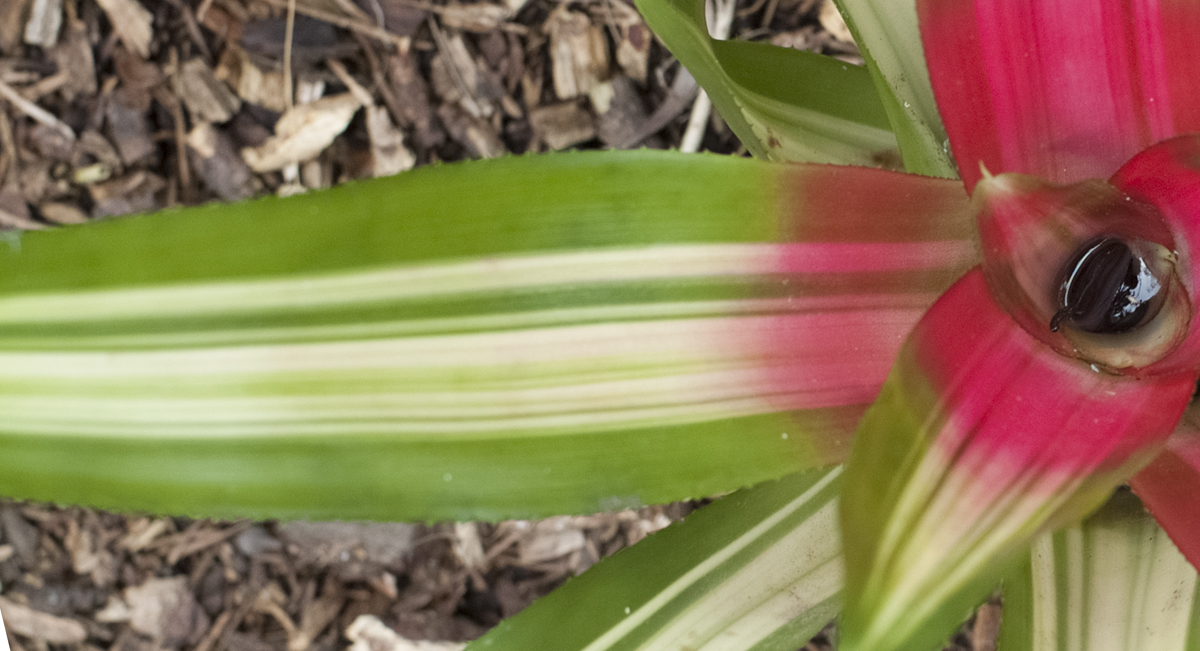
Fimbriae - fringe, edge, extremity, border
as in this leaf with a green edge - the Anthocyanins (red pigments) are formed in the center with a distinct green edging.
|
|
tricolor:Three colours usually green, cream and pink |
| |
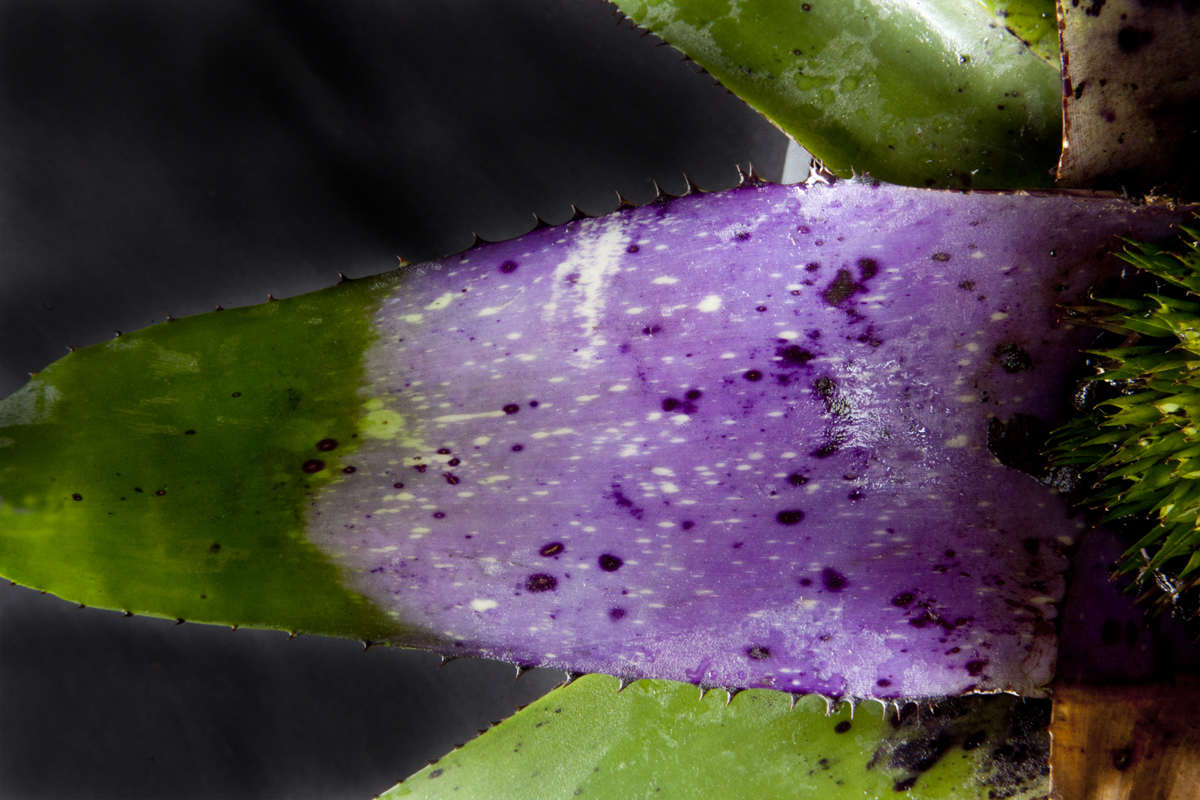
quadricolor: quadri-: Four (quadricolor = four-colored.)
|
|
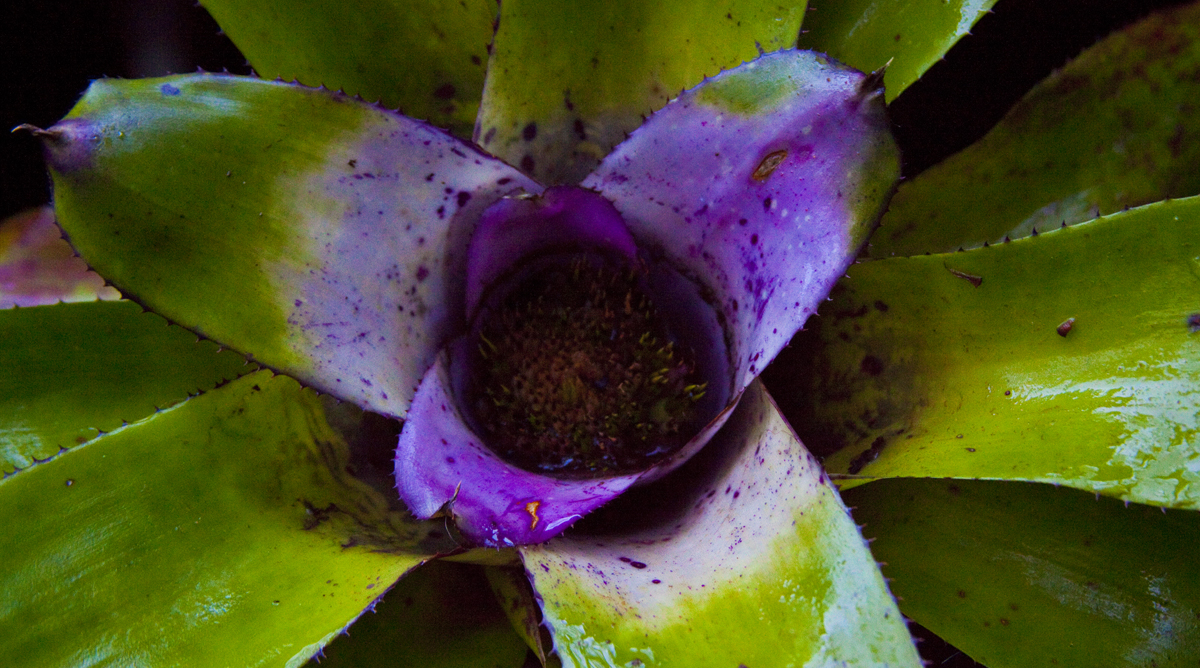
marmoration: variegating so as to resemble marble |
|
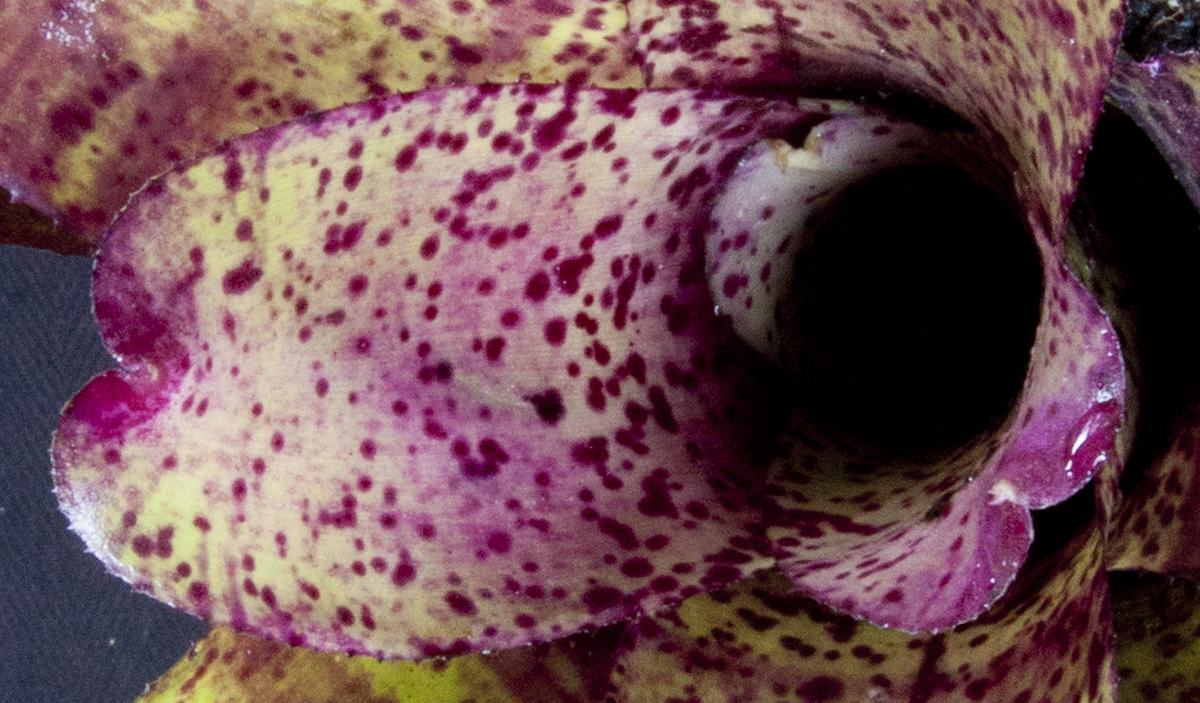
concentric: concentrica, with intensification of color in the center |
|
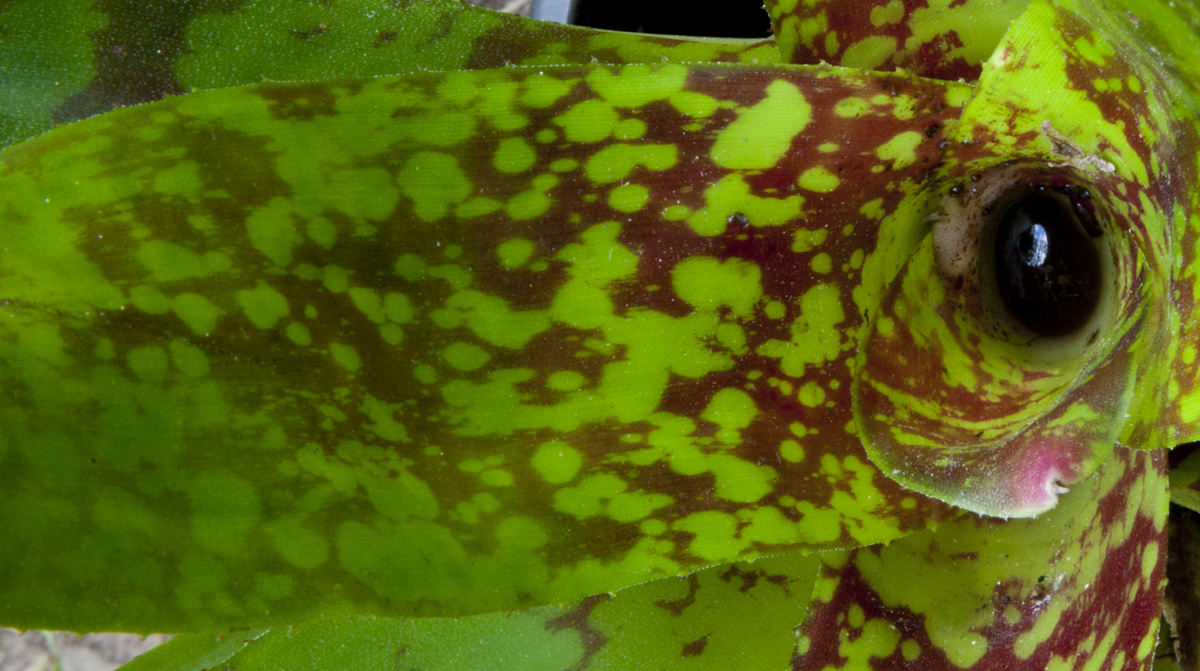
maculation: maculate: Spotted; blotched; marked with spots. Red on green |
|
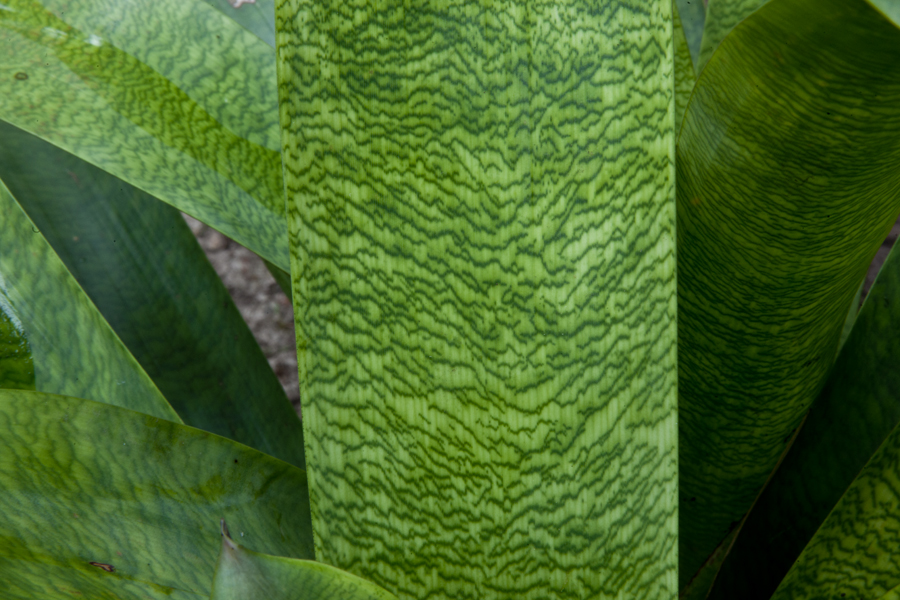
maculation: maculate: Spotted; blotched; marked with spots. Green on red |
|
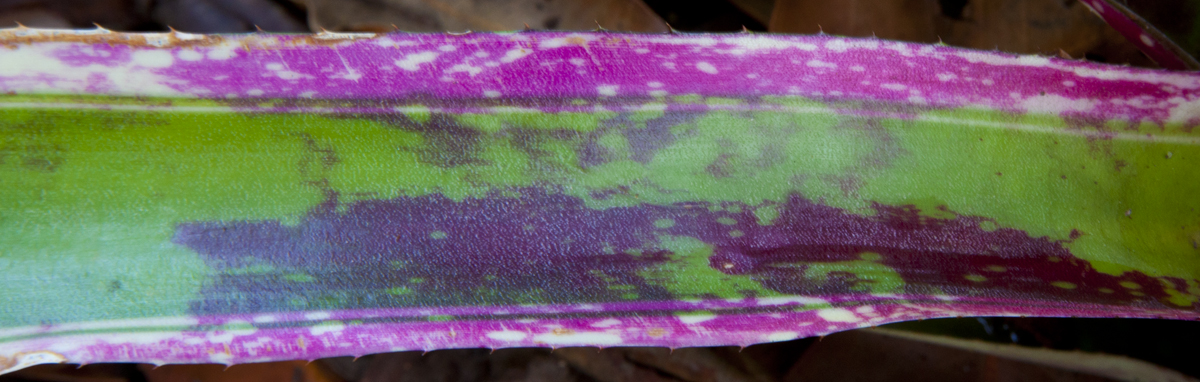
fenestralis: With window-like openings; referring to the light-green rectangular areas on leaves which give the illusion of windows |
|
Iacio: to throw, cast, hurl, lay, scatter, diffuse, here the contrasting pigmentation is scattered randomly across the leaf |
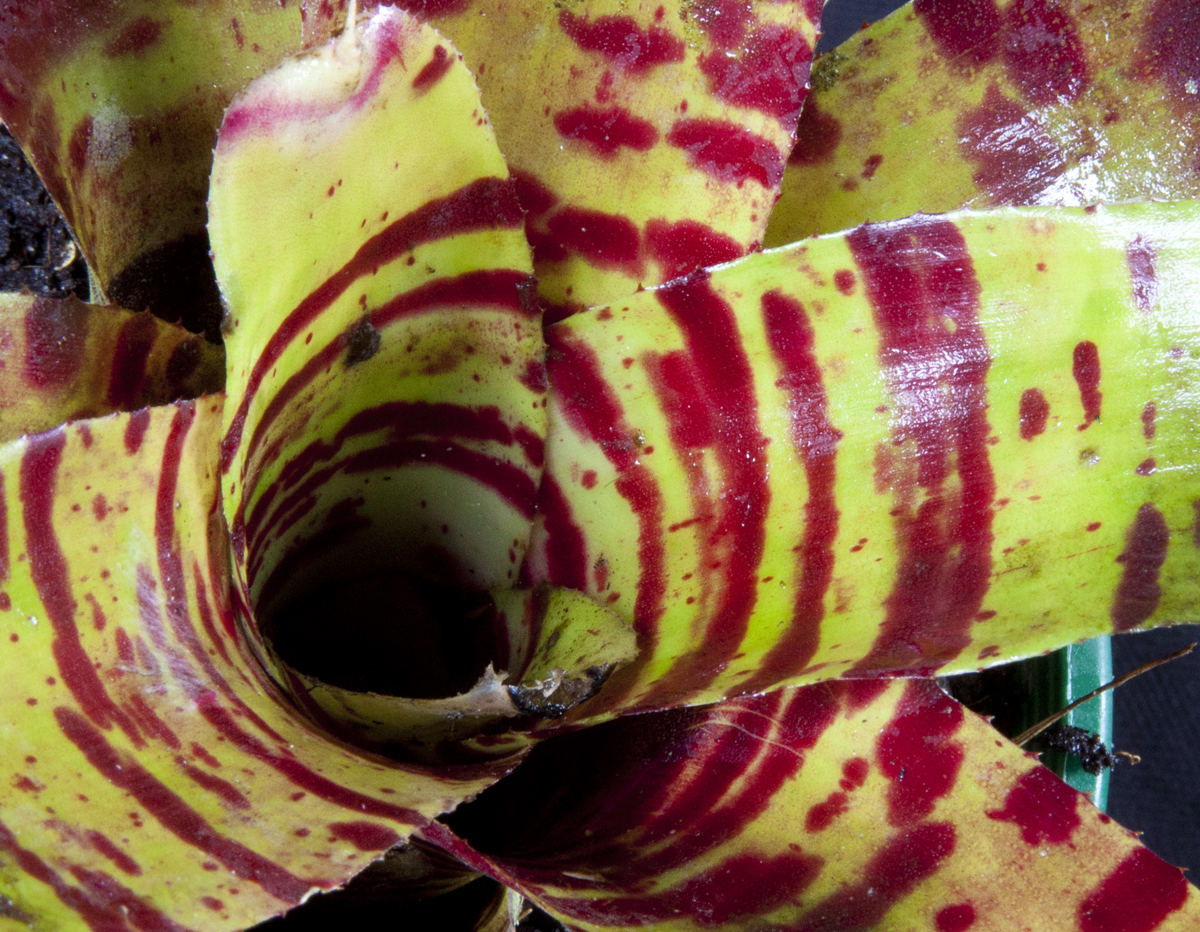 |
Zonation: zonata: Zoned; banded with distinct colors |
Often the pigmentation is only visible on one surface - the inside of the leaf or the outside. Some plants from erect tube like forms like Billbergias and Aechmea where the outside of the leaf is the underside of other plants like Neoregelia which form open rosettes. I describe these as follows.
|
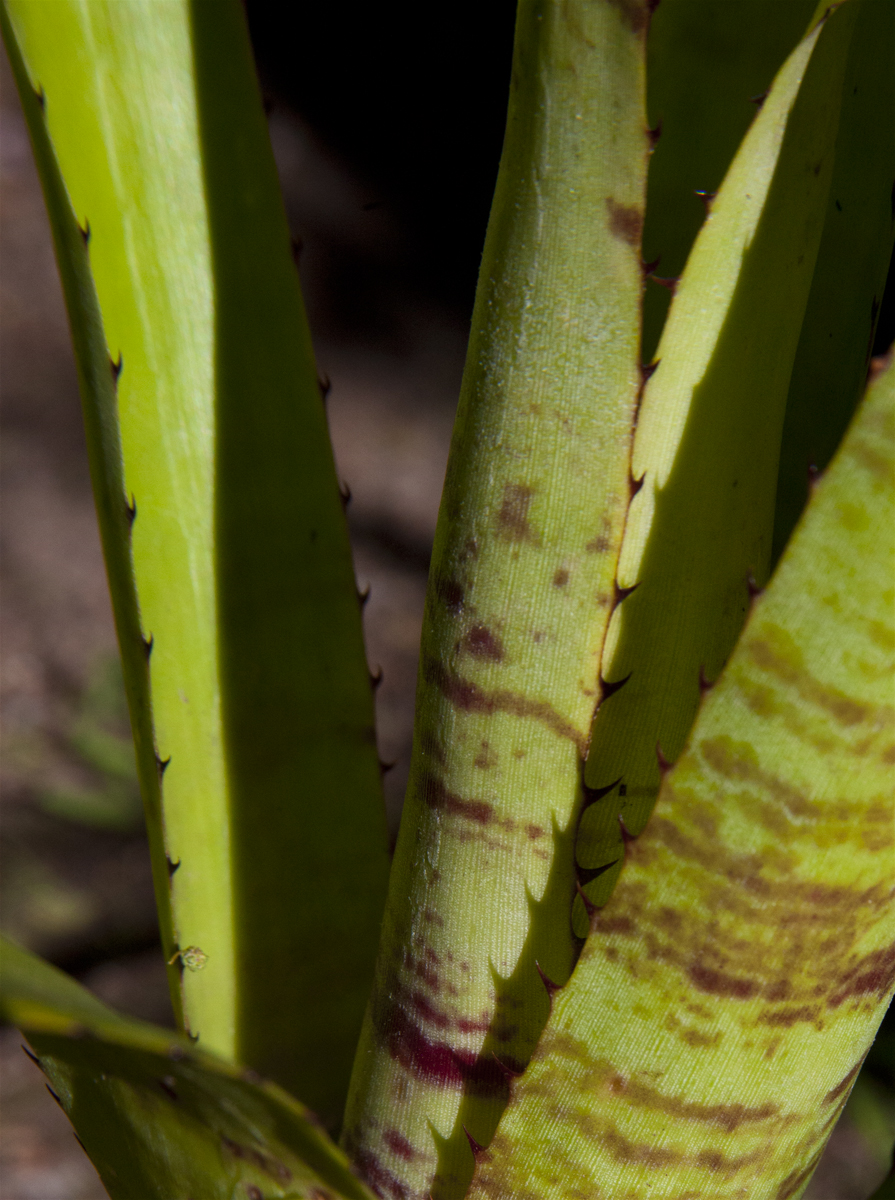
Intus - Inside - this is the inside surface of the leaf facing inwards - in Neoregelias it is the most visible aspect of the leaf, while in the tube forms like Billbergias it is concealed by the tight form |
 |
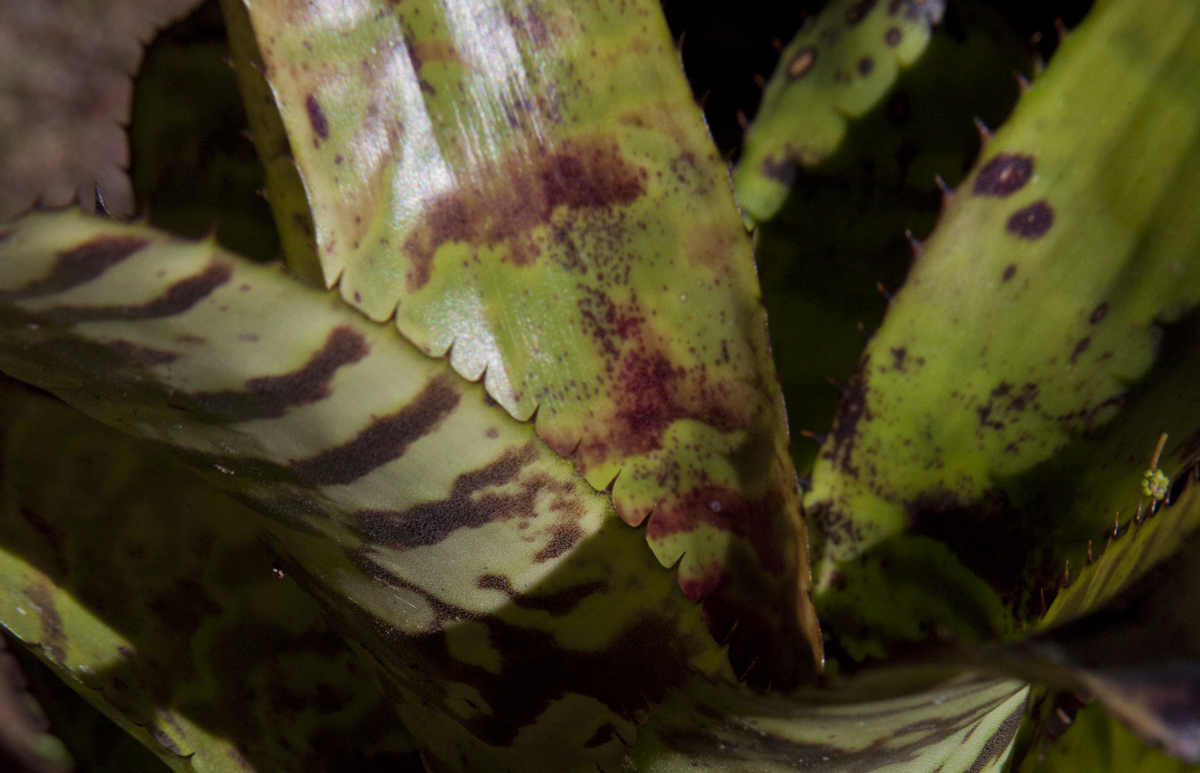
Extrinsecus - outside - this is the outside of the leaf facing outwards - in Billberiags it is the most obvious leaf surface. In mature Neoregelias it is the leaf surface facing downward is is less visible. |
 |
In some plants the pigmentation from Extrinsecus to Intus is partial or with a different pattern. In the leaf of this Achmea the pronounced pigmentation is on the underside of the leaf - Extrinsecus, while the pattern on the upper side - Intus is less pronounced. |
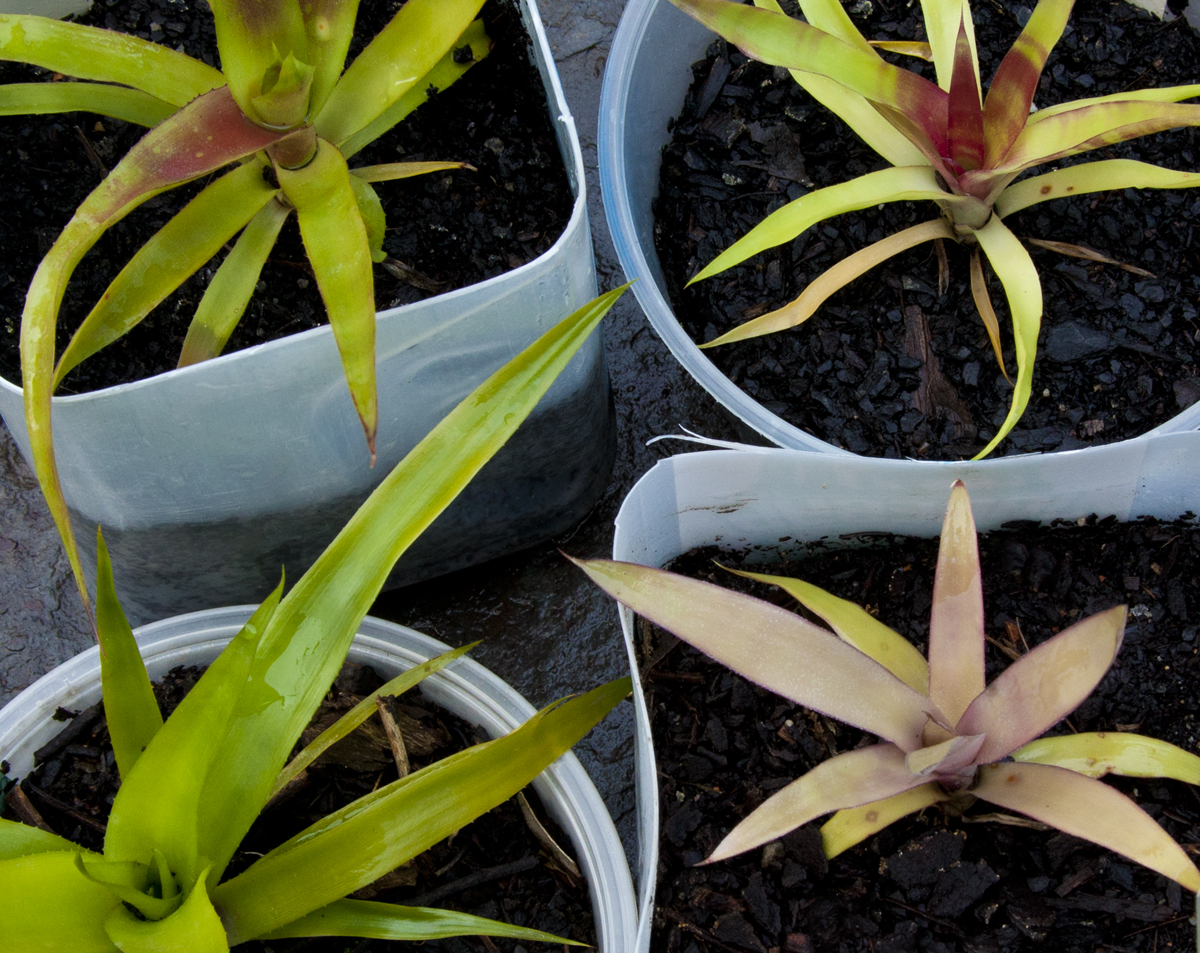
Further to this pigmentation can alter significantly during the life of the plant. Through the juvenile stage, pre-flowering flowering and as the parent plant dies. Combined Bromeliads produce the greatest range of colours and patterns imaginable.
Glossy or matt leaves
Reflected light is usually diffused in character, that is, the reflections occur about equally in all directions from a surface that has a matt or textured finish. Polished mirror like surfaces also yield specula reflections where most of the source light is reflected in a beam. The gleam of sunlight on automobile chrome is an example, but less extreme examples that occur in nature where many surfaces produce both diffuse and specula reflections. Any surface that appears 'shiny' such as certain leaves or rock surfaces, or wet pavement can produce specula highlight, as can crystalline substances like ice, sand or snow. They are direct reflections of the light source, they are far brighter than a diffuse area and they can lend a sense of brilliance to a photograph. When observing light on the subject that you are photographing it is important to observe the relationship between the diffuse areas and the specula reflection. It is also important to see diffuse well-lit areas and deep shadows. The same applies to observing and photographing Bromeliads.
 |
When light hits and object it reflects off at the same angle it. It is a similar principle to shooting a pool ball. The angle light hits the object is called the angle of repose while the angle it reflects off at is called the angle of reflection. Some Bromeliad leaves have quite glossy leaves where the light is reflected from their leaves in a different manner that a plant dusted with a layer of trichomes. With glossy leaves hot spots can appear, and these will shift as our position is moved in relationship to the plant leaf and the sun. |
 |
However many all Bromeliad leaves have trichomes on the surface and pronounced coatings break the light up reflecting it in a multitude of directions so the leaf appears to have a matt surface. |
Trichome patterns
All Bromeliads have trichomes which are the tiny cells that are able to take moisture into the plant. While these might be invisible to the naked eye 0n some Bromeliads, others produce a profuse trichome pattern that not only becomes visible, but becomes a key aspect of the plant aesthetic and shows as a contrasting white silver. This is most often pronounced on the underside of the leaf, so in tall tubular forms like Billbergia the pattern becomes highly visible, where as with vase forms like Neoregelia the trichomes on the under side of the leaf surface and are less visible from above.
While the silver trichome cells are often dusted over the entire leaf surface, they can also form in bands that also add to the visual attraction of the plant. Trichomes on the leaves of Bromeliads vary a great deal. On some plants they can be arranged flat on the surface and be invisible to the naked eye, on other plants they can cover an entire leaf with an even pattern of long hair like cells. On some plants the trichomes are arranged in patterns, often strong bands across the leaf. However there are some plants like Alcantarea where a fined dusting of trichomes is present on the upper leaf surface. Of course Tillandsias have profuse trichomes coatings on both sides of the leaves and no pattern.
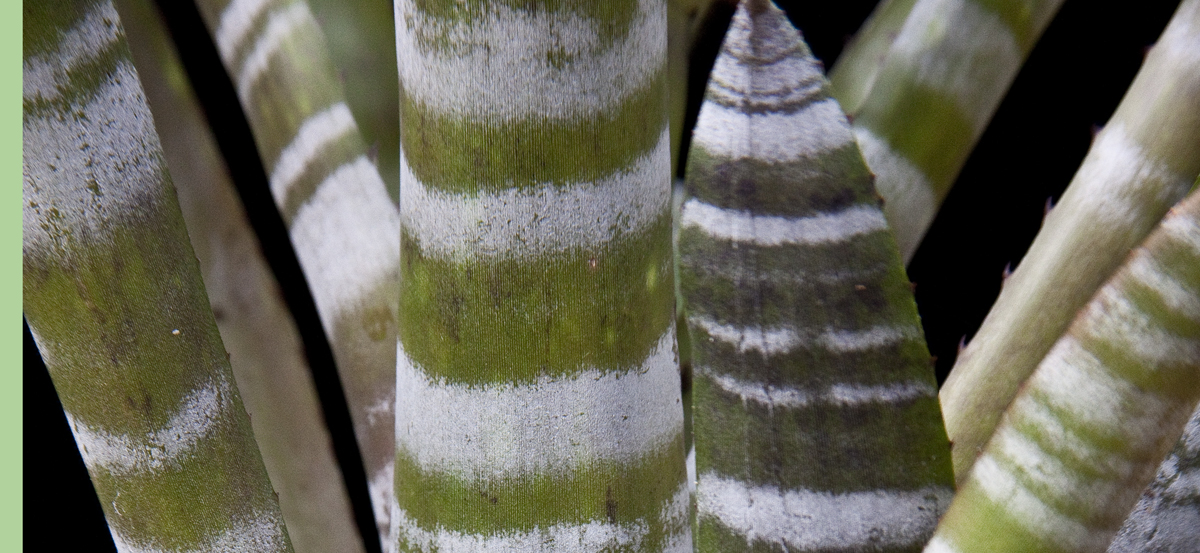 |
Strong trichome banding on a Billbergia |
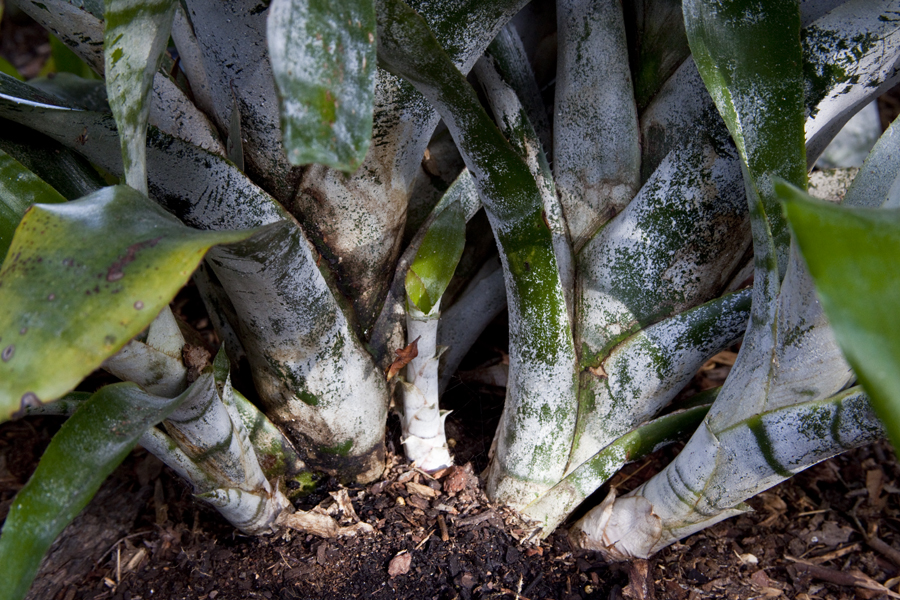 |
Heavy dusting of trichomes on an Aechmea |
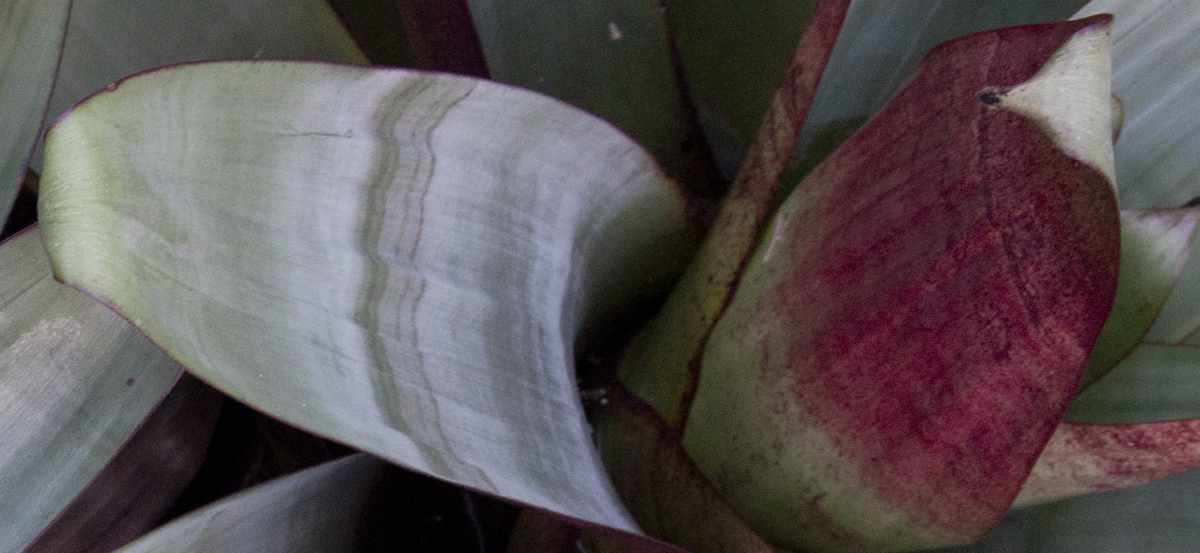 |
Trichome banding on the upper surface of an Alcantarea leaf. |
Spikes or Spine colour
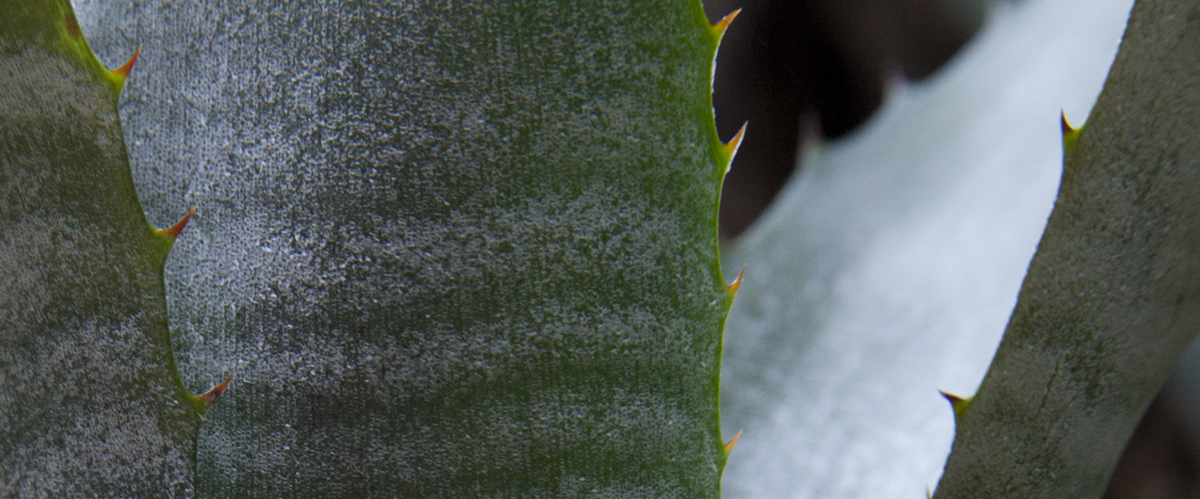
Billbergia vittata

Neoregelia carharodon "Tiger"

Bilbbergia Elegens Pink |
Many Bromeliads from the sub- families Bromelioideae and Pitcainioideae have a series of spikes or spines that run along the leaf edge. This can be a feature in plants from popular genera like Aechmea, Billbergia, Neorgelia, Dyckia and Puya. In plants from the Tillandsioideae sub-family the leaves have smooth edges with no spines.
The spines vary considerably, they may be quite small and insignificant, almost invisible, where they are felt by running a hand up the leaf edge, to large hazardous spikes that are stiff, sharp enough to inflict nasty wound, yet a seductive feature of the plant. Sometimes the spines form only near the base of the leaf, while other plants form spines the entire leaf ending in a sharp spike at the leaf apex or tip.
On some plants the spines are more pronounced on the juvenile leaves and fade off as new larger leaves form. Most often the spines contrast colour (black or red) to the leaf and can offer another striking visual effect to the plant. They can sit on the leaf edge as a series of almost symmetrical triangles or form a barbed almost fish hook shape, there might be wide spacing between the barbs or that can form with a narrow spacing. Some barbs can be quite soft, semitransparent lighting up under direct backlight, or thick and opaque. Not only do these factors combine to offer an intriguing visual diversity between species, but also between hybrids. |
Leaf Shape
In aesthetics a closed shape is an important aspect and we can apply this to the leaves of Bromeliads.

|
The shape of Bromeliad leaves can vary greatly from species to species, but can also differ because of the aspect a plant is grown in. For instance many plants grown in full sun grow many shorter broader leaves while the same plant grown in a shady spot might develop less elongated thinner leaves, so drawing absolute comparisons can present an impossible challenge.
However, there are distinct differences between various species and hybrids. The leaves might range from needle-thin as in Acanthostachy strobilacea to broad as in Alcantarea regina. No matter where each of these plants are grown the leaves of one will never look like the other. While the length of the leaves of different species can contrast widely we can get a sense of leaf shape by applying an X Y ratio. That is the length (X) of the leaf to the width (Y).
|
 |
|
| |
Leaves are most often symmetrical but some irregularity can occur particularly when the plant is subjected to stress like lack of water, or physical damage.
|
| |
All Bromeliad leaves have some curvature In length, they can be nearly straight, curved. This curved form is designed to channel water into the center of the plant
|
| Leaf Crossection |
Aesthetically curving lines and arches are associated not only with gracefulness but strength and in many Bromeliads the repetitive arching leaves is an attractive feature. While in architecture the arches used for bridges, openings in buildings are elegant, they also offer great strength to these structures and this applies to the leaves of plants. So the cross sectional curve of a leaf affords extra strength in high winds, as does the longitudinal curve where the leaf often tapers to a point. |


|
The cross-section of Bromeliad leaves have some curvature, there appears to be no plants with a hard fold or V shaped leaf. This curvature can be quite pronounced as Acanthostachy strobilacea where the form is almost circular (circuitu) or in some plants concave and much flatter. Some leaf edges can curve back towards the centre of the leaf. (involute). Again this curvature acts to collect water and channel it into the centre of the plant.
The degree of this curvature varies up the length of the leaf, but we can get a sense of the relative proportions by measuring the X Y axis across the blade of the leaf.
|
 |
In this Neoregelia leaf the yellow lines indicate a convex form, but the leaf transitions to a convex from indicated by the red line. |
| |
stiff to soft
The first juvenile leaves of a pup can differ from the secondary leaves produced as the plant matures, then the leaves can also alter as the inflorescence and flower elements form. |
Plant Form
This refers to the overall shape and form of the plant. Up right tube form as in most Billberbergias, spreading rosette,as in Neoregelias
The inflorescences produced by bromeliads are also regarded as considerably more diverse than any other plant family. Some flower spikes may reach 10 meters tall, while others only measure 2–3 mm across. Upright stalks may be branched or simple with spikes retaining their colour from two weeks up to 12 months, depending on species. In some species, the flower remains unseen, growing deep in the base of the plants but the leaf area surrounding the flower may turn a vivid colour in a few months and keep this colour for a year. Neoregelia flowers form under water in the vase and as the petals open only the tension of the meniscus prevents the pollen from getting wet.
Bromeliad Hybridization
This is a very long term project, with unpredictable results - as an extension of the Classification work.
The concept is to cross-pollinate some of my Bromeliad collection, germinate and then grow the seed on to maturity for 4 -5 years, observe what eventuates and then name the new hybrids after fossil fuel machines - this also becomes a link to the Plant Room project.
In the past 100 years about 70 - 86% of apple, pear genes in the USA have been lost through mono-cropping - Nature creates genetic diversity. As current human activity has destroyed the diversity we could argue, most of these genes were obviously crap genes and we did not really need them.
However isn't it wonderful that scientists are able to combine the diminishing gene pool into new plants through what we call GM crops - This is not creating new genes but rearranging existing genes. From what I can gather, we still don't know how to create new genes, so one wonders what we have lost. While the Bromeliad Hybrid project looks to create as many variations as possible, it also looks to find plants with a suitability to grow in air gardens and other living art works.
The naming of Hybrids usually equates to the growers romantic notions of nature. A characteristic of the plant ( ie. Neoregelia Rose sunset, Neoregelia Painted Desert), a person (ie. Neoregelia Anna 49, Vriesea Rafael, Billbergia Henry Teusher), a place (ie. Billbergia Santa Barbara, Aechmea Mexicana, Neoregelia Australian Affair)
However the intension with the new hybrids I am producing is to name them after carbon emitting devices like car names - I am looking to Latinize the names like - Ford Falcon etc. - ( Fordea Falconii) - still have to work out the exact Latin.
heterosis: Hybrid vigour. It is sometimes observed that the offspring of cross-mating between different species often grow quicker in the first generation and ultimately grow larger than the parents. This effect is important in the cultivation of plants.
hybrid: the result of a cross between differing plants or taxonomic units
I have also discovered this practice of producing more "green" than one consumes is called super sustainable - The Swedish are looking to produce a super sustainable city - http://www.greenmuze.com/build/design/930-the-super-sustainable-city.html
for more info - artist
journal
find other plant works by the artist >>
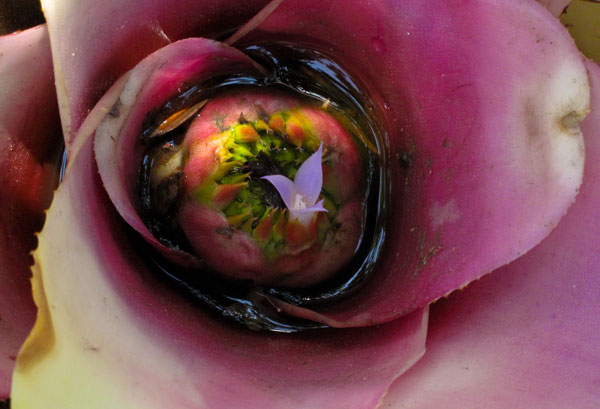 |
Neoregelia flower - the first flowers were pollinated in the summer of 2007
Cross-pollination takes place between 2 plants of different species. |
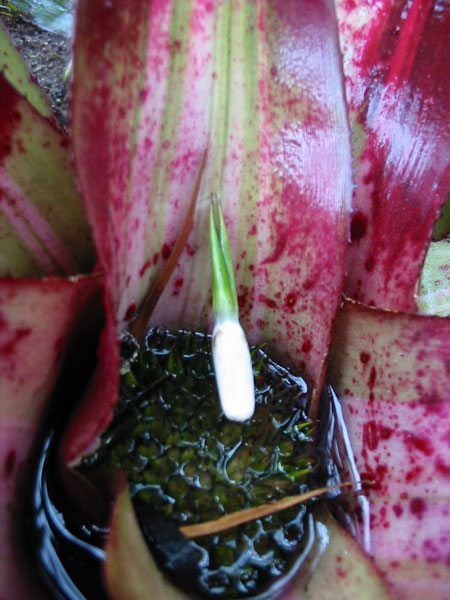 |
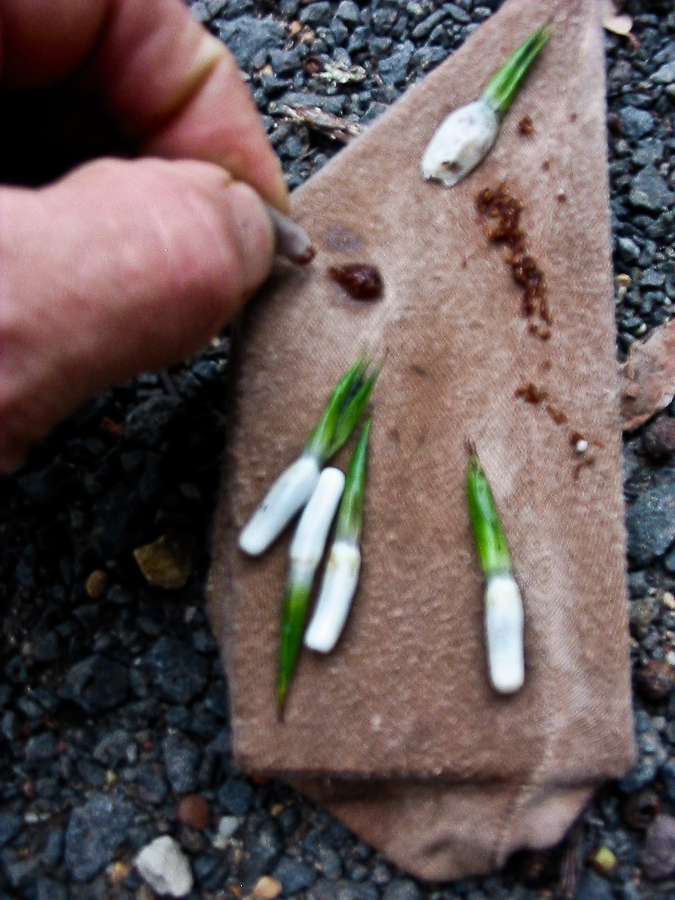
Ripe seed capsule from a Neoregelia - |
|
the seed is inside mixed in a sticky jelly and is squeezed out - 2007 |
Tillandsia Seed catching and germination
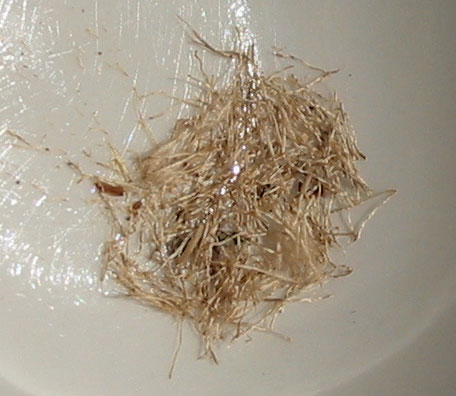 |
Viresea seed highly magnified - 2007
Seed takes about 4 - 6 weeks to germinate |
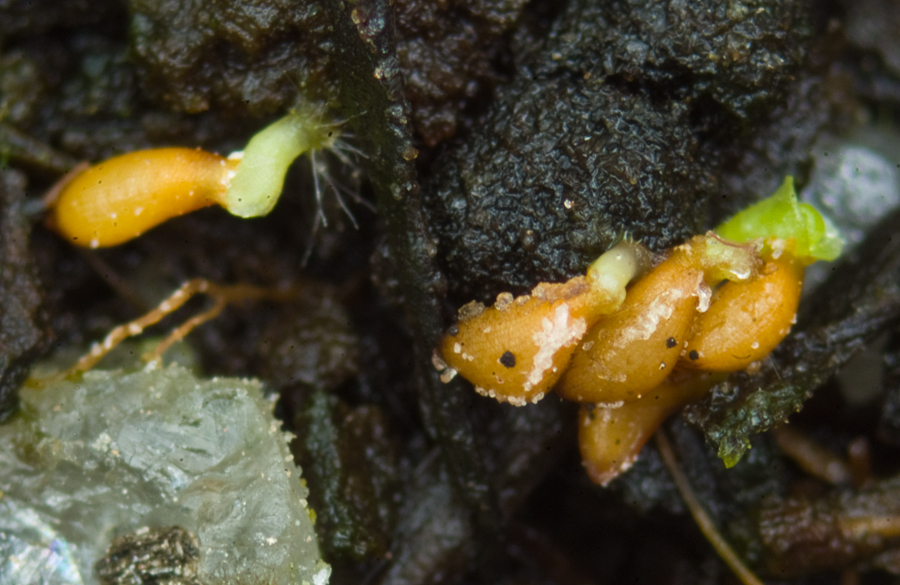
First signs of Aechmea seed germination
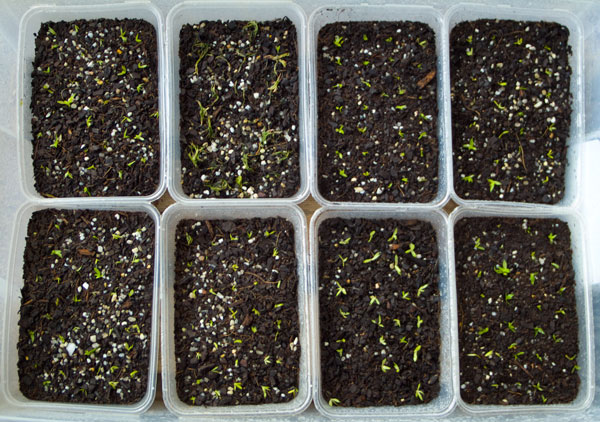 |
Fresh seedlings several months old - 2007 |
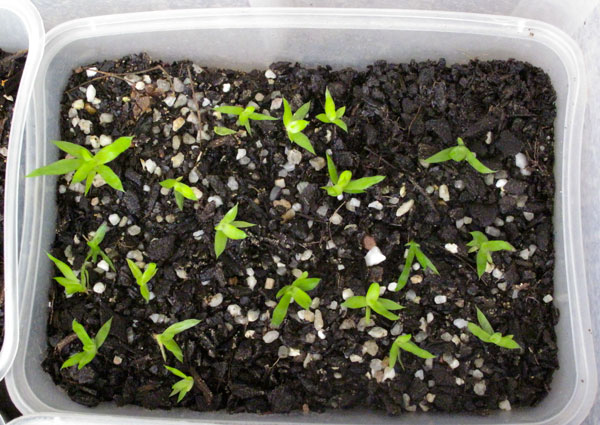 |
A close up of seedlings about 12 months old dec 2007 |
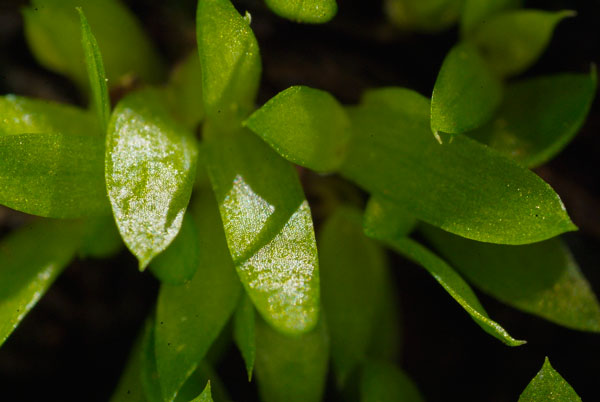 |
Neoregelia seedlings - detail 2007 |
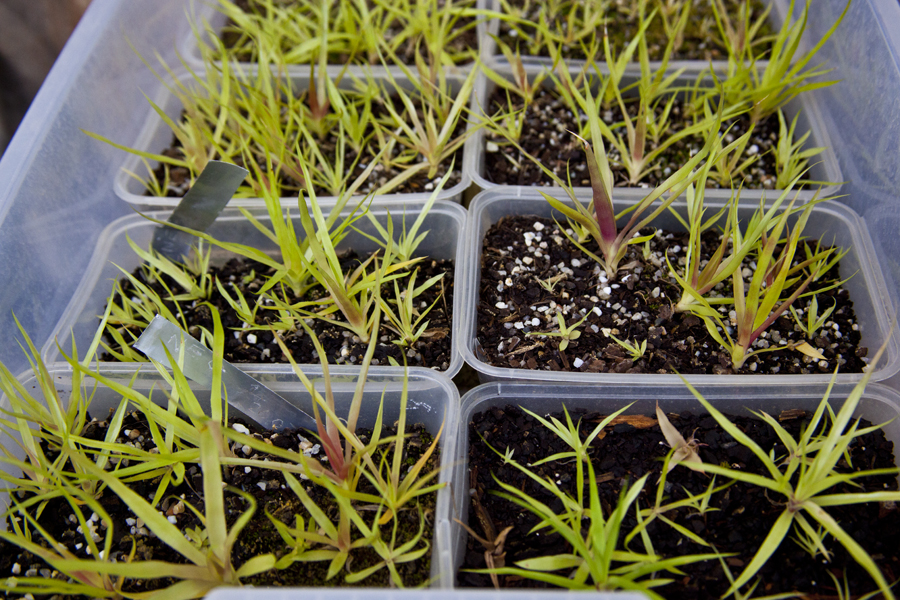 |
Neoregelia Seedlings after 3 years - 2010 |
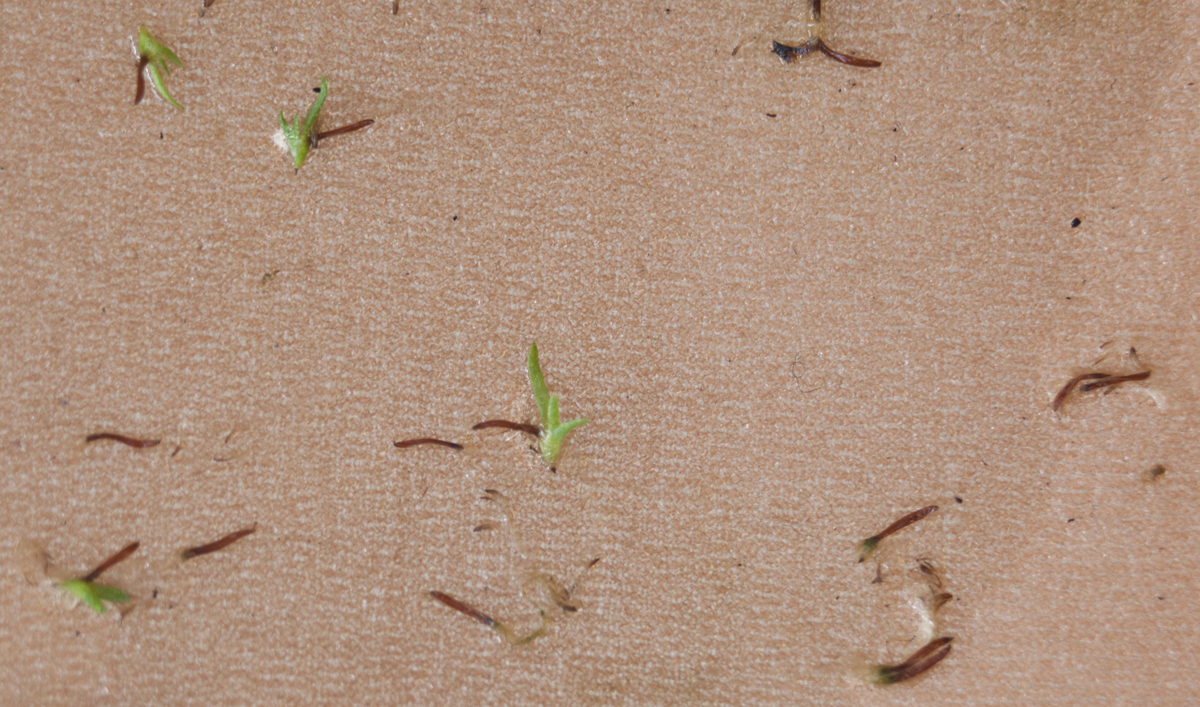 |
Vriesea seed germinating 2011 |
|
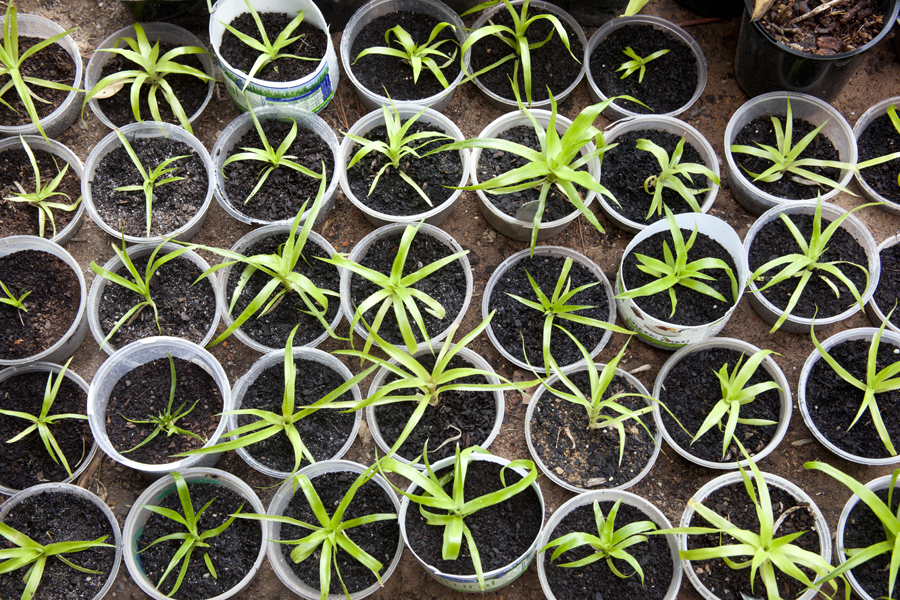
the first batch of Billbergia Seedlings - one year old - these grow quickly - 2010 |
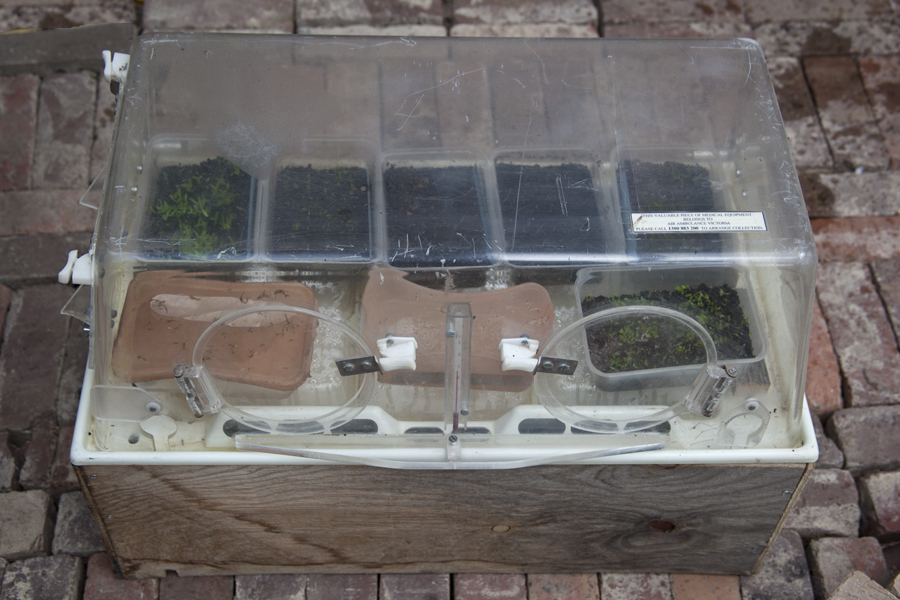
|
A few years ago I started growing bromeliads from seed - I asked Mauice Kellett who lives a few Km away and is my Bromeliad Guru the best way of doing this -
He suggested using a humidicrib - that they keep newborn babies in but said I would have to improvise as they are either 2 expensive or unobtainable second-hand - 3 days later at the recyle shop there was one for $6 - it had a small crack in it and had been de-accessioned from the air ambulance service of Vitoria - |
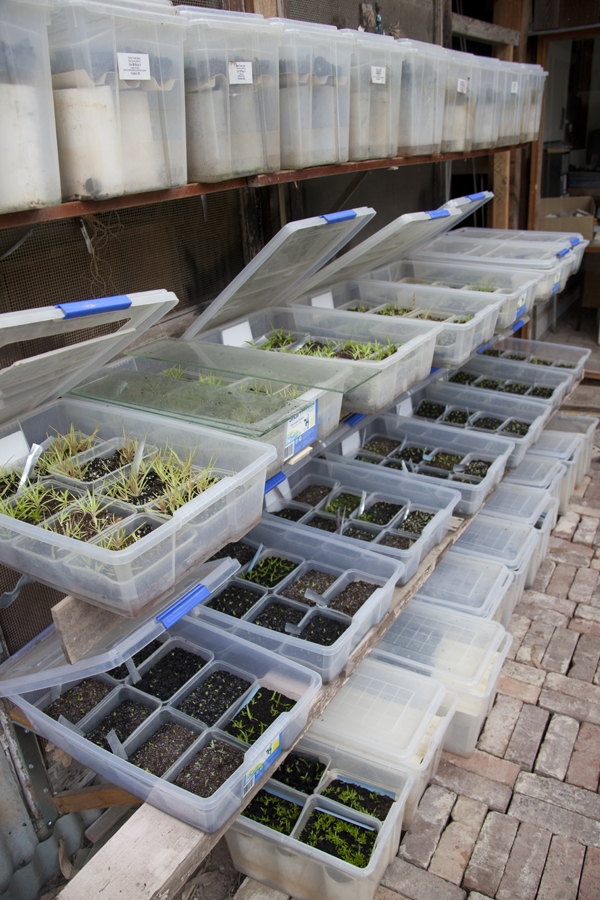
Thousands of seedling bromeliads in what has become known as the LLoboratory |
It's perfect - I place a light bulb underneath it to keep the temp between 20 -30 degrees and water in the bottom tray - lift the seed trays up from this level and it delivers a perfect temp an humidity for germination - I now have more than 5,000 plants - growing in other boxes - these have water in the bottom with the seed trays lifted above this so the temp and humidity is good to grow them on |

|
Every time I tend to the seeds I think of all the little babies that would have been flown around the state in the humidicrib unit and wonder who these people are, how old they are and what they do?
Anyway the unit now has another function
Recycling is wonderful! |
Below is some info about Quaker botanists:
Phillip Miller:
He submitted a paper to the Royal Society: ‘A method of raising some exotic seeds which have been judged almost impossible to be raised in England’, Phil Trans., Vol. 35, p. 485, 1728.
Apparently the principal interest of all Quaker botanists of the time was to introduce to England plants and trees from abroad for medicinal or other special use or of escpecial beauty.
Miller also wrote several books.
Peter Collinson:
He germinated and cultivated seeds and plants from America. N.G. Brett-James in his book, The Life of Peter Collinson, gives a list of all the plants he introduced.
John Bartram:
He collected seeds and propagated plants in America.
John Fothergill:
He imported and propagated foreign and exotic seeds (he introduced nearly 100 species), many of which came from Bartram.
John Coakley Lettsom:
His outstanding introduction was the mangel-wurzel as a food crop.
Other notable Quaker botanists/horticulturists of this period include James Backhouse, Robert Were Fox, Edward Newman, Henry Doubleday of Cogeshall, Thomas Lawson, William Curtis, William Woodville, John Dalton, William Allen, Lewis Weston Dillwyn, and William Phillips.
I commend to you the writings of Geoffrey Cantor on the Quaker interest in botany and art, for example:
http://digitalcommons.georgefox.edu/cgi/viewcontent.cgi?article=1000&context=quakerstudies
http://faculty.education.illinois.edu/westbury/paradigm/QUAKER_S.PDF
You may also find some references in:
http://etheses.bham.ac.uk/631/1/Morries10PhD.pdf
|