|
Construction
& installation of Chambre Noire -Impressions
de Lumière - from an artist in residency at Chateau de Blacons, France - 2007 © Lloyd Godman
Process - Construction - Installation
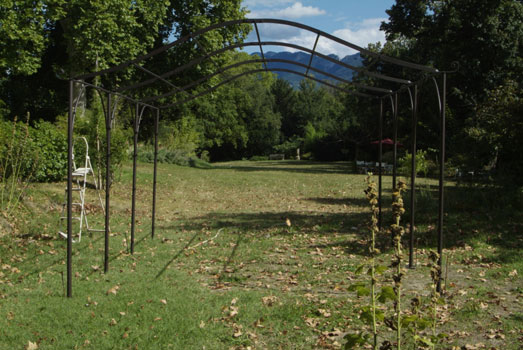
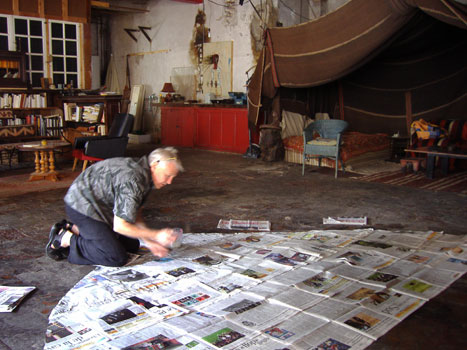
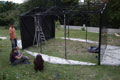
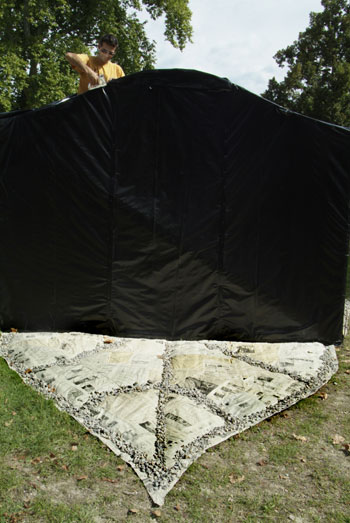
Above - 17
Aug 2007 - The structure was assembled for the enclosure
in the garden in front of the Chateau. This was a standard
pergola, of elegant design, made of steel and very strong.
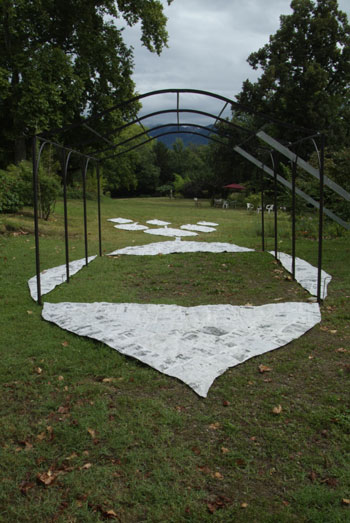
Right - There
was a problem getting this to sit exactly level and we had
to use some temporary braces on the side to stabilize the
structure upright. The large newspaper leaf shapes were laid on the ground to begin the process of growing the photosynthetic images in the grass. |
|
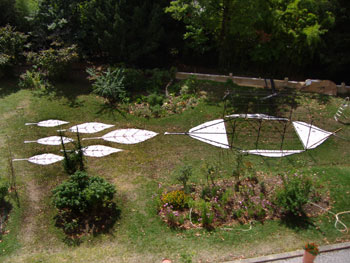
22
Aug 2007
the timber supports that will be wired onto the were painted
black to match the structure and the lining. During the
next morning there was a down pour of heavy rain and some
of the paint was washed off.
View
from the window of the 4th floor of the Chateau locating
the leaf forms and the structure. |
|
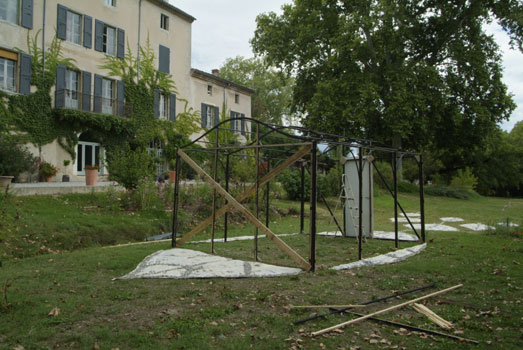
Above - 24
Aug 2007
I spent the morning trying to track down a larger image
file in Australia that we could use for the poster and invite.
This seemed to take for ever with on resolution by the end
of the day. Tess left for Sweden and in the afternoon I
moved up to stay at the Chateau in the Gîte.
Right - By
the time I had arrived at the Chateau from Crest, Cédric had installed some
of the wooden frame work and the door.
|
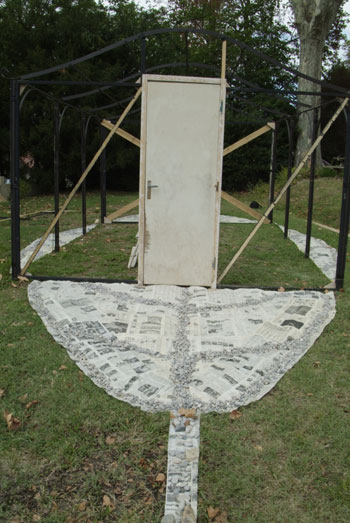
|
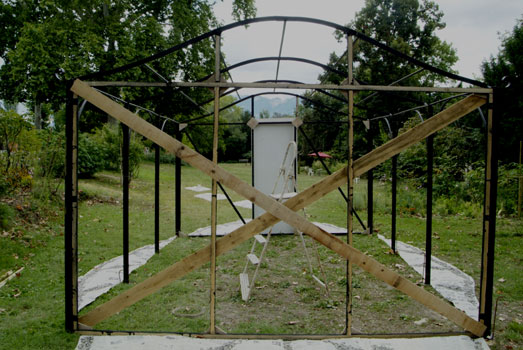
Above - We
had to put a cross brace at the end to keep the structure
vertical.
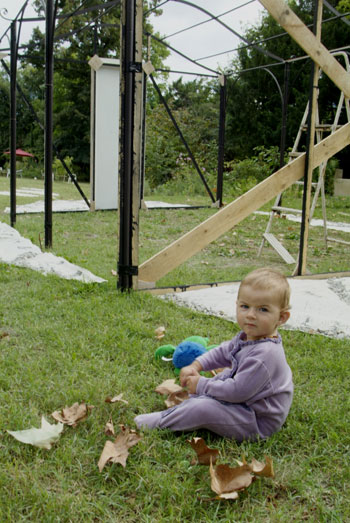
Right - We
had lots of wonderful support from Celeste, their 9 month
old daughter who is the dearest little girl - always smiling and a real delight.
|
|
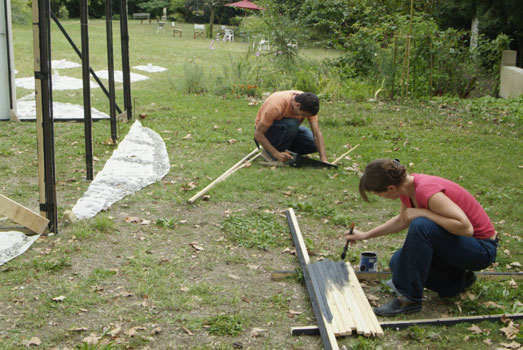
By the late afternoon, Cédric, Beatrice and myself
finished off the wooden components of the structure.
|
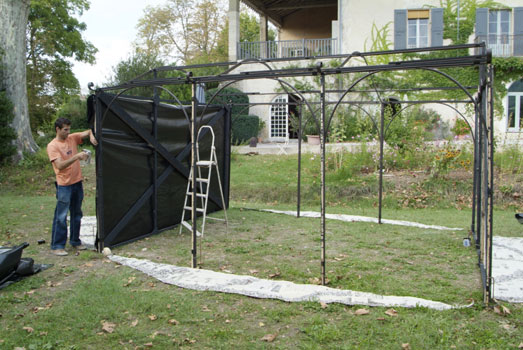
We
kept working into the evening installing the first sheets
of black plastic on the structure. |
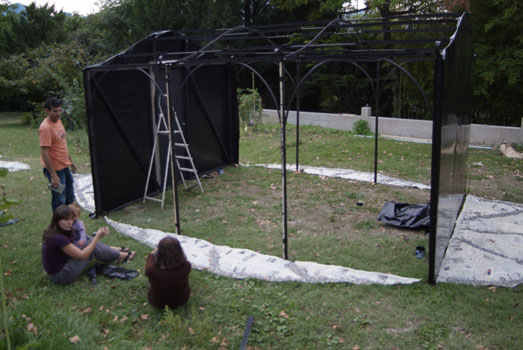
By
8pm when we sat down for the evening meal, the 2 end walls
had been covered with black plastic.
Daniel
Van de Velde, who had worked at the Chateau arrived to pick
up his fascinating hollow trees works that adorned various parts of the garden. With Daniel staying over
the night in the Gîte with me we had a good talk about his work and the garden project he was working on. He was due to deinstall his work the next day.
|
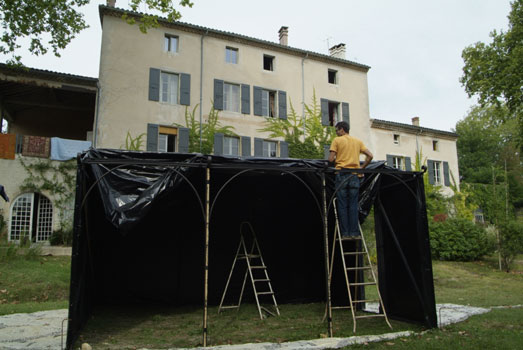
25
Aug 2007
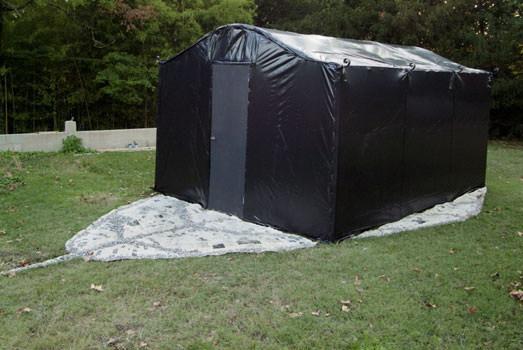
The next day more plastic is applied to the structure until it is completely blacked out with plastic. |
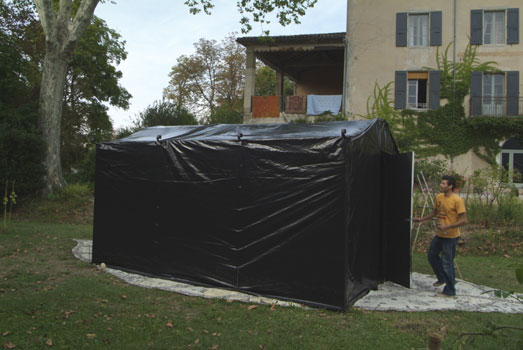
Above & right - Cédric applying the finshing touches to the darkend structure |
|
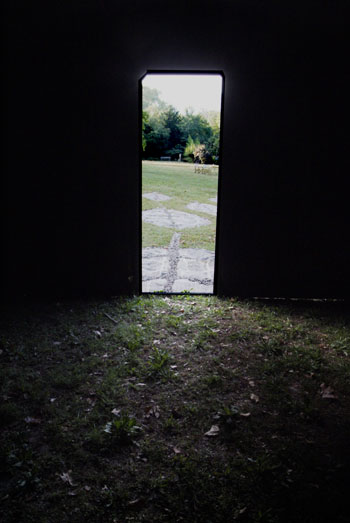
Above - The view from within the darkened structure through the aperture of the door to the garden |
|
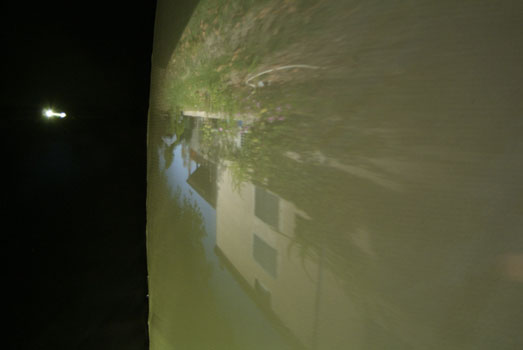
Above - In
the process of installing there were a few small holes in
the plastic, each one of these operated like a pinhole camera.
I experimented with a large white cardboard sheet, placing
it on oblique angle to the wall with the aperture, and photographing both the projected
image and the pinhole with a digital camera..
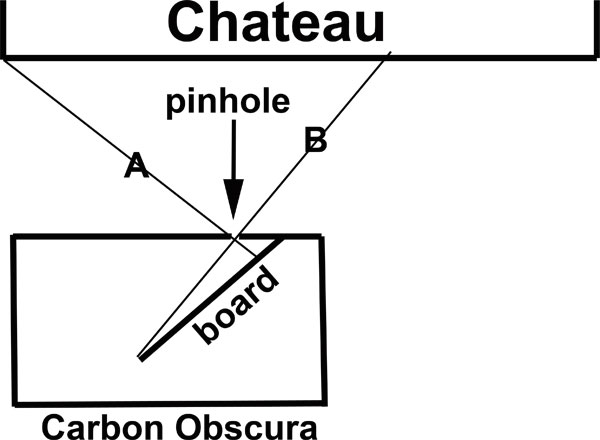
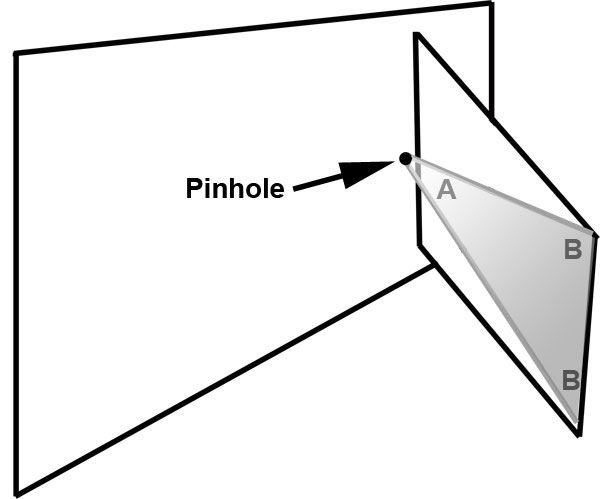
Right - Although the image was hardly perceptive to the naked eye, with an extended exposure of about 30 seconds the images recorded well with the digital camera. There are three fundamental aspects of photography made clear by this image.
1. any image from an aperture like these pinholes is vertically and laterally reversed, (upside down and back to front) you will notice the image is upside down.
2. the further and wider the light projects the more it falls off, this is also linked to the next aspect - perspective. Because there is only the same amount of light falling on a larger surface area the illumination is diminishes. So, the image is brighter closer to the pinhole ( A) and less intense further away ( B).
3. the closer to the pinhole the smaller the image while the further away larger the image - this works in exactly the same way we might use the movement of a view camera to correct perspective. In the drawing the projected lines once passed through the pinhole alter - B becomes longer than A.
There is also a fourth fundamental of photography - the wider the opening that lets the light through the less sharp the projected image - and like wise the smaller the aperture the greater the sharpness.
|
  |
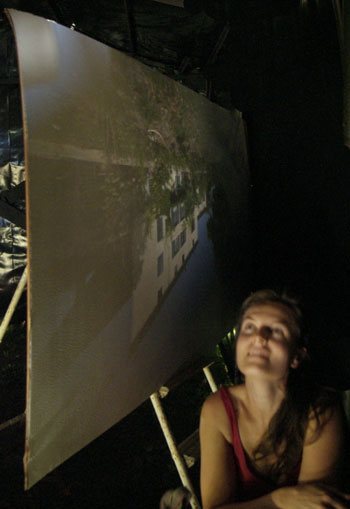
Above - With an exposure of 30 seconds I
made a portrait of Beatrice sitting in front with the Chateau
projected onto the cardboard.
|
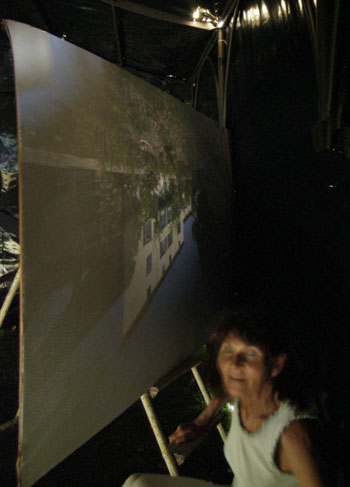
I
also made a portrait of Evelyn sitting in front with the
Chateau projected onto the cardboard. |
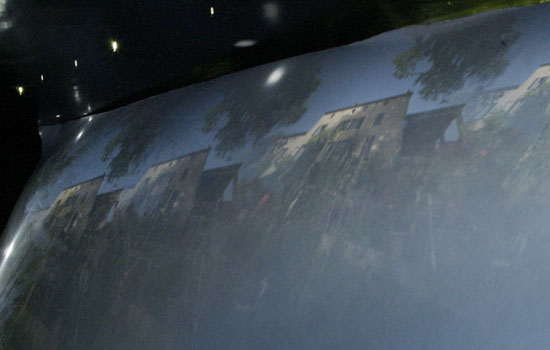
As I began to sketch out the design each pinhole
projected an image of the scene outside - here we see four images
of the Chateau. Notice the pinholes on the wall. As more and more pinholes were made in the fabric of the structure the images became more and more confused until it reached a point where the only reference were the circles of light which were the sun projected from each pinhole image.
|
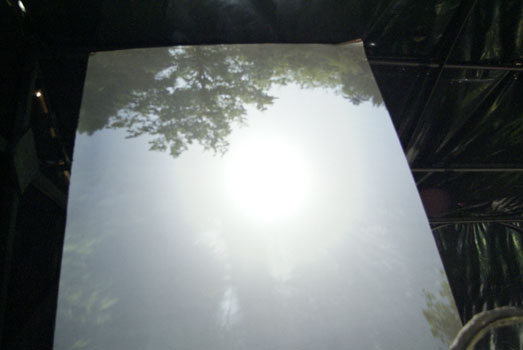
Here
the board is held up to a pinhole in the roof and the trees
and sky photographed with a digital camera.
More info on the phenomenon of light and the camera
|
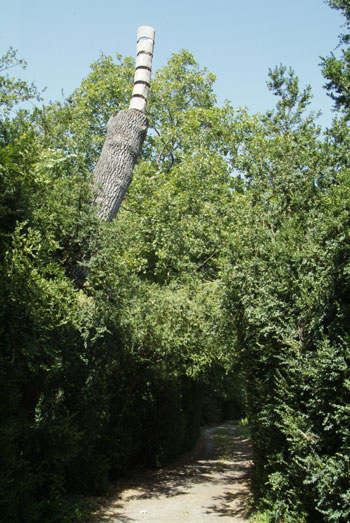
One
of Daniel Van de Velde's work installed in the garden of the Chateau.
|
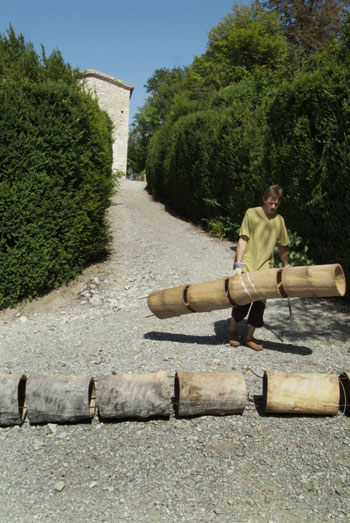
Daniel
Van de Velde, deinstalling his work in the morning. |
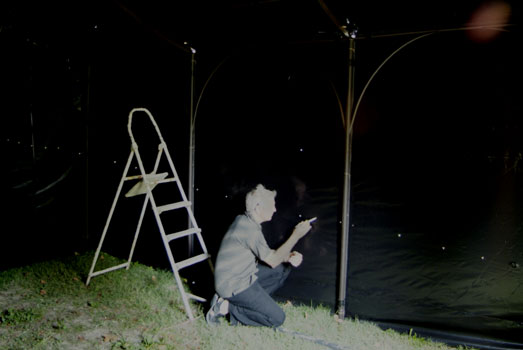
Later
in the afternoon I began pricking out the image on the plastic. |
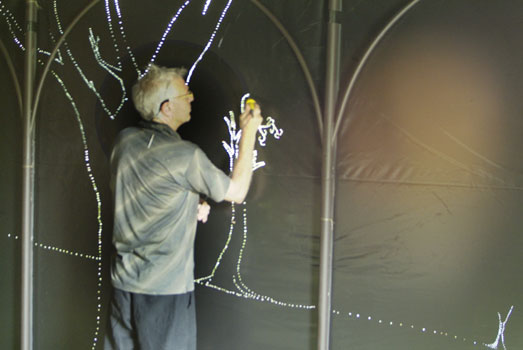
26
Aug 2007
The black polythene as like black carbon particles in the atmosphere, it stops some wavelengths of radiation form the sun (light) and lets others through (heat). This is exactly what is happening to the planet with carbon emissions, while heat is radiated through the particles of black carbon, the photons or light are actually reduced. As photons are implicated in evaporation the planet gets warmer but there might also be less rain.
Very early in the morning I resumed pricking out the images in the
black plastic. However the heat became incredible the
sun grew stringer and I had to wait until later in the day. |
| |
|
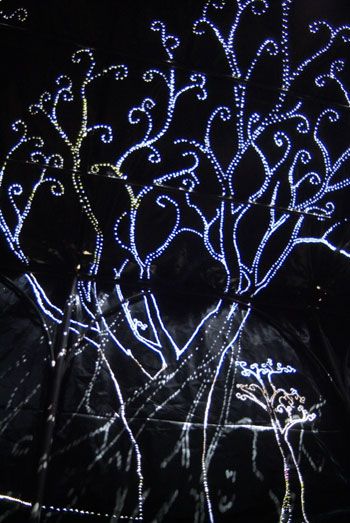 |
27
Aug 2007
By 10 am the work was nearly complete and the sun was projecting
images across the floor and walls. Of course the abstract
projection patterns were in constant change as the sun moved
across the sky.
|
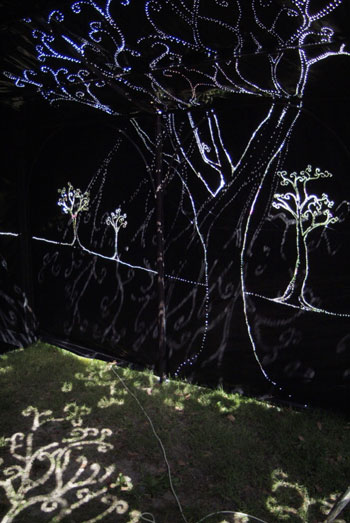 |
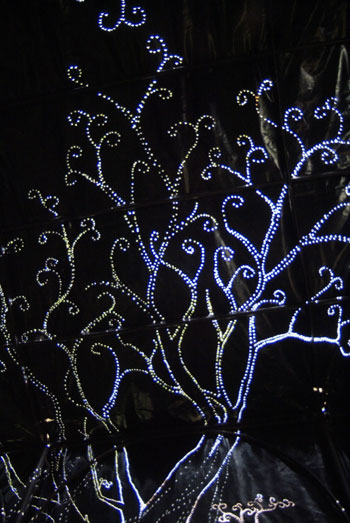
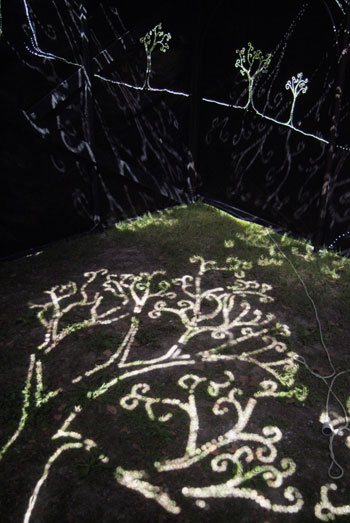
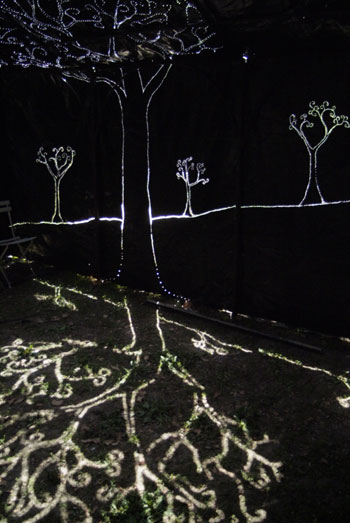
The myriad of pinholes projected a series of small circles onto the ground and walls - which interacted with the real pinholes in the wall and roof. The lines of light projected on the floor are actually mad up of thousands of individual circles of light, and each one is the sun from a pinhole image. |
 |
|
 |
|
|
|
|
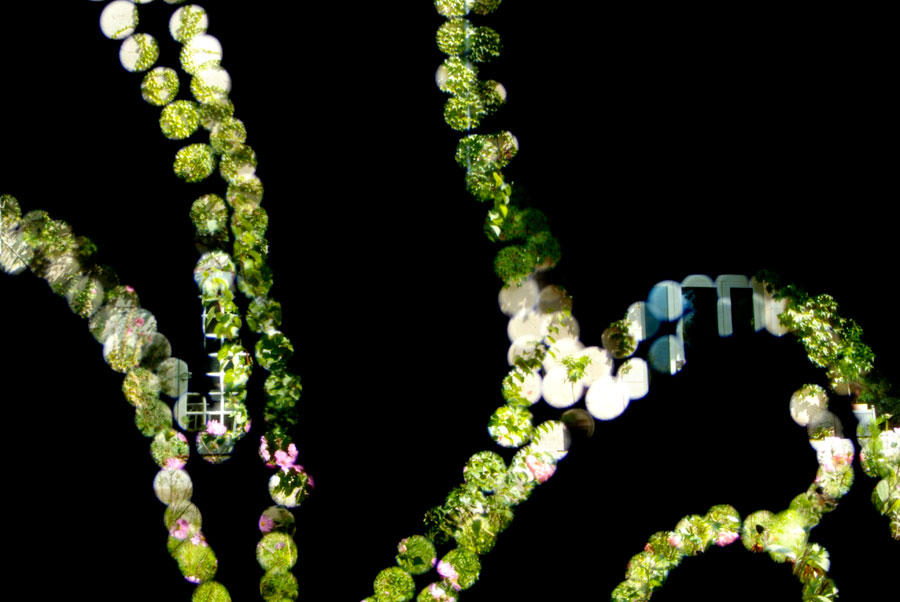
When you place your eye close to the wall the scene outside is revealed as a series of circles. |
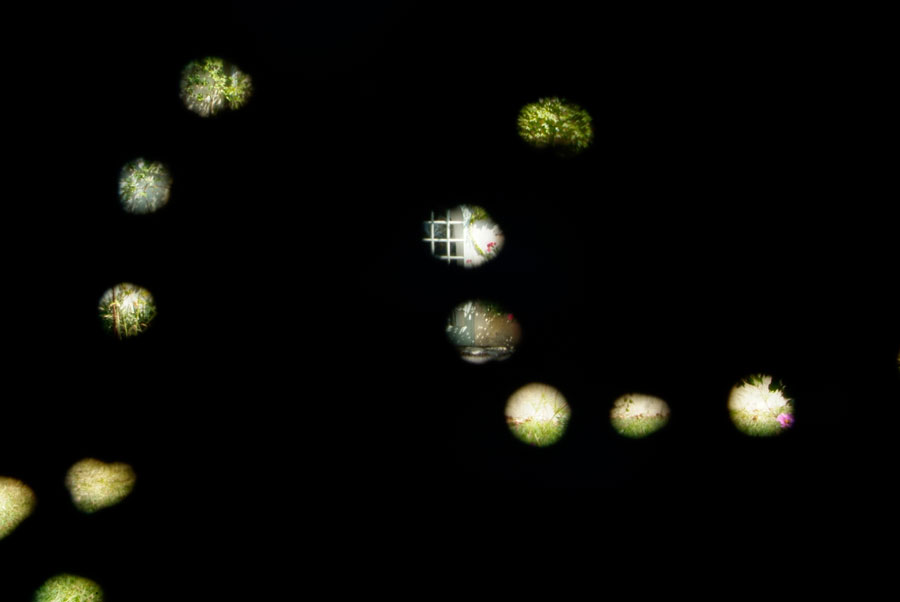 |
When this is photographed with a small aperture - f22 @1/10 second each of the holes is recorded as a separate circle. |
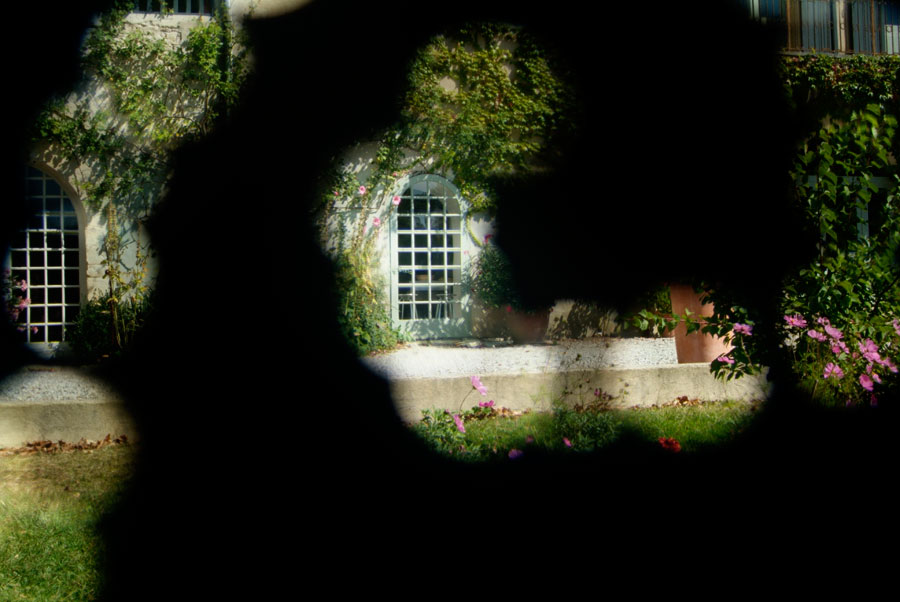 |
However when the aperture is opened up with the focus set on infinity - f4.2 @1/60 second - due to the circles of confusion, or unsharpness of each of the pinholes they over lap. |
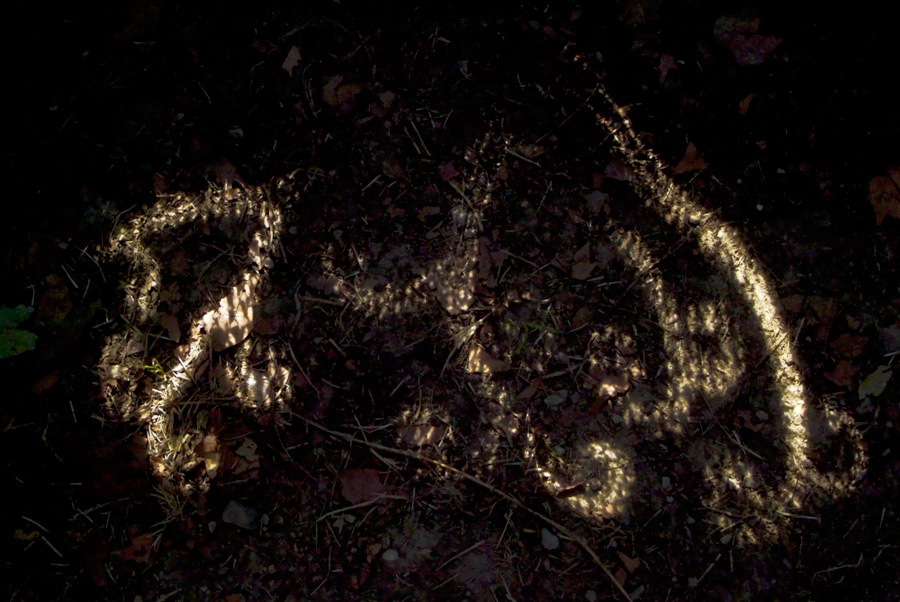 |
Here we see the lines of pinholes projected onto the ground - |
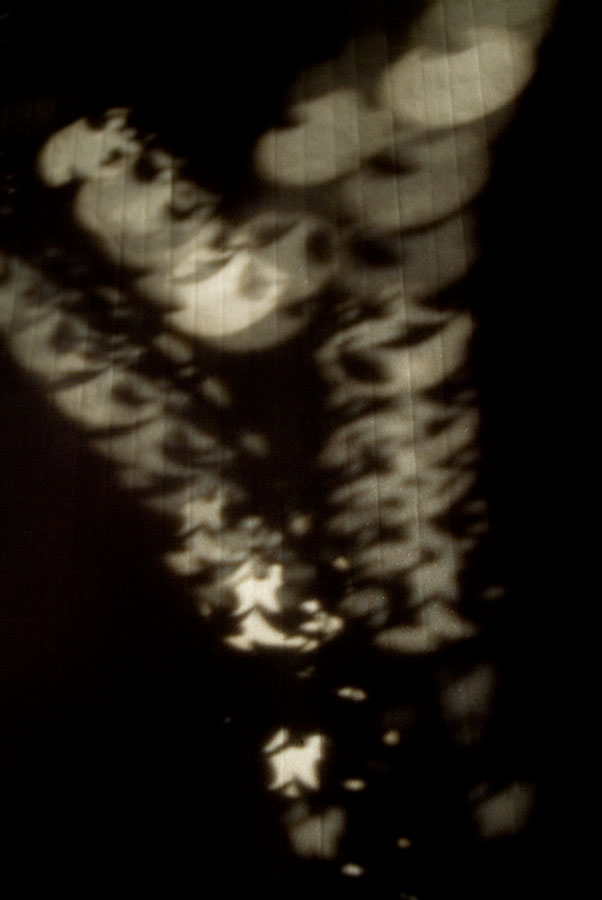 |
In this image leaves of tress fall across the area where the sun is in the pinhole image - Each one is slightly different because of its position - in some there are no leaves over the sun - so the circle is complete. It was fascinating watching the shadows of the leaves move in unison when the wind blew - |
|
Sept 2008
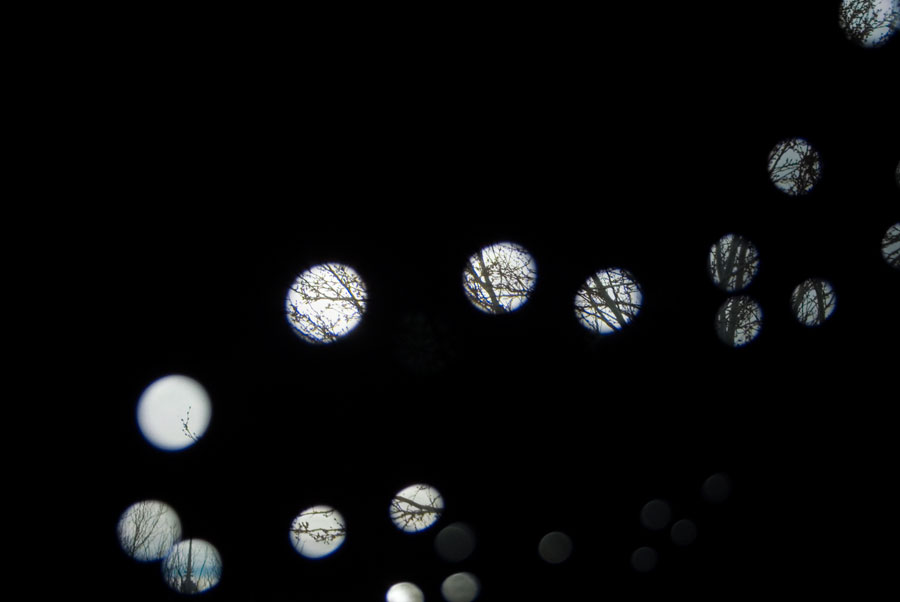
This is an image of the Carbon Obscura in Canberra, looking through the pinholes to the trees out side.
I have been experimenting much more with the fog and light inside the carbon obscura - when there are hundreds of pinholes the only reference we see is the small circle of light that are the sun in thousands of pinhole images. The other representations that we might see when there is only one pinhole, are imperceptible because the light overlaps too much and diffuses the image. |
| |
Circle of illumination - each circular image projected through the pinholes falls off in illumination towards the perimeter - this is called the circle of illumination and happens with all lenses - Normally we ar not aware of this because the camera frame is designed to crop only a section of the projected image.
|
| |
Image sharpnesss - with a pinhole camera, the sharpness of the image is dertermined by the diamiter of the opening or aperture
- |
| |
Focal length - the focal length of a pinhole image is determined by the distance between the pinhole and the projection screen or sensitive material
- |
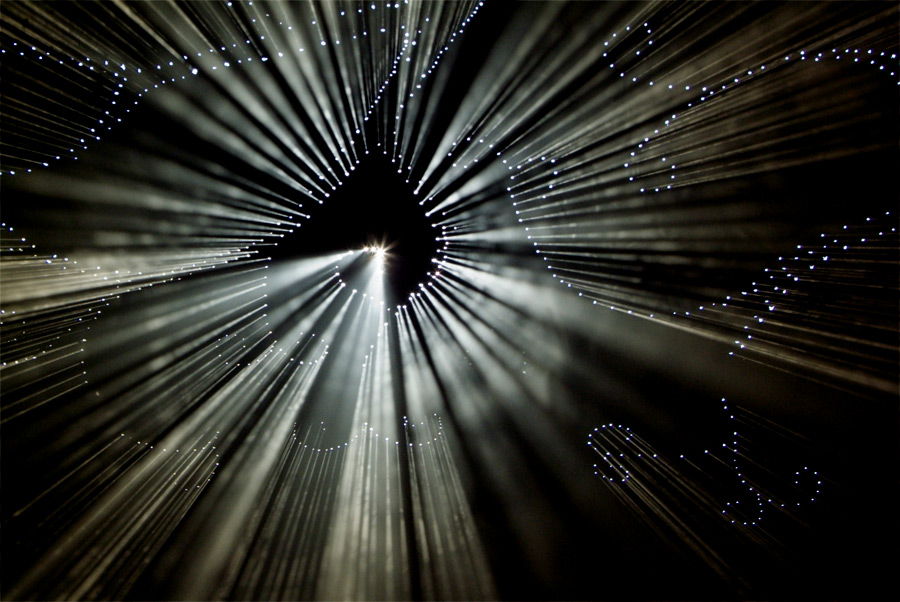 |
So each ray of light in an image like this is a projection of the sun in a separate pinhole image -
However, because of the interferance ot the projected light waves over lapping each other, the projected scene fails to materialize in a manner that we can percieve.
The sun materilises because of the extreme difference in light intensity between the sun and the other light projections. |
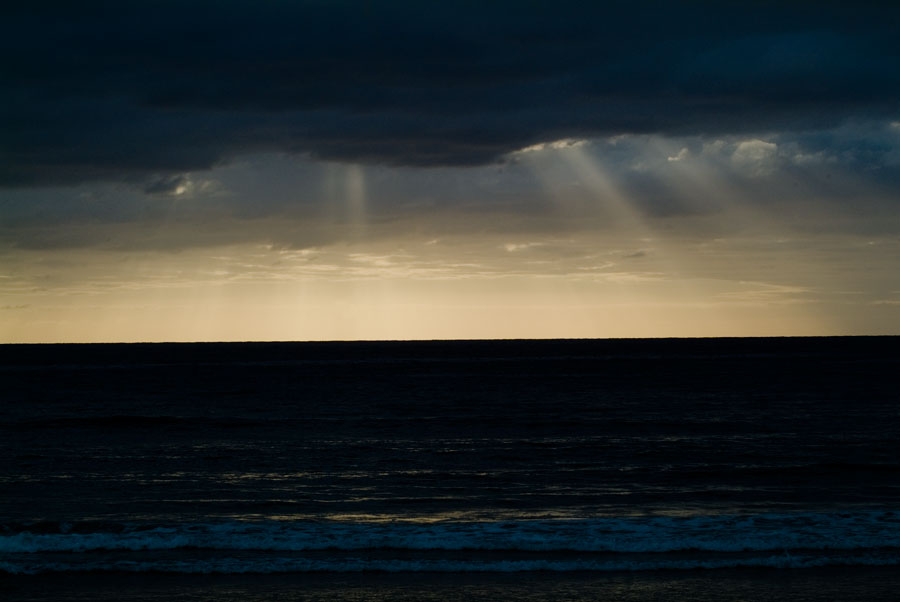 |
we see similar examples in nature - for instance the rays of sunlight projected through the clouds - here the opening in the clouds forms an aperture that lets the light from above project through. |
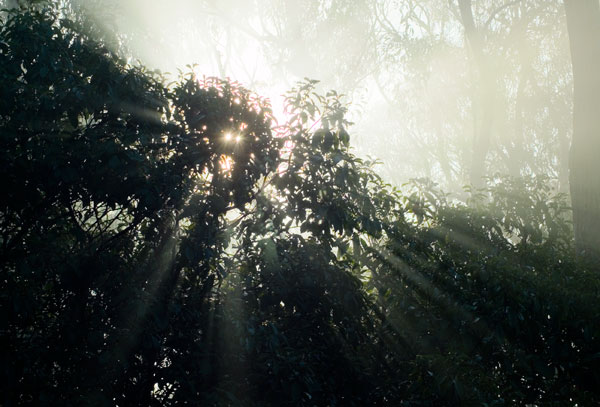 |
When we see a similar effect with sun rays streaming through the leaves of trees in morning fog, what is actually happening in the image is the gaps in the leaves of the tree are producing tiny apertures like a pinhole image and each ray of light is a projection of the sun, similar to the carbon obscure pinholes. So in a situation like this the leaves are actually forming a multitude of natural cameras - its just we cant see the other projections.
|
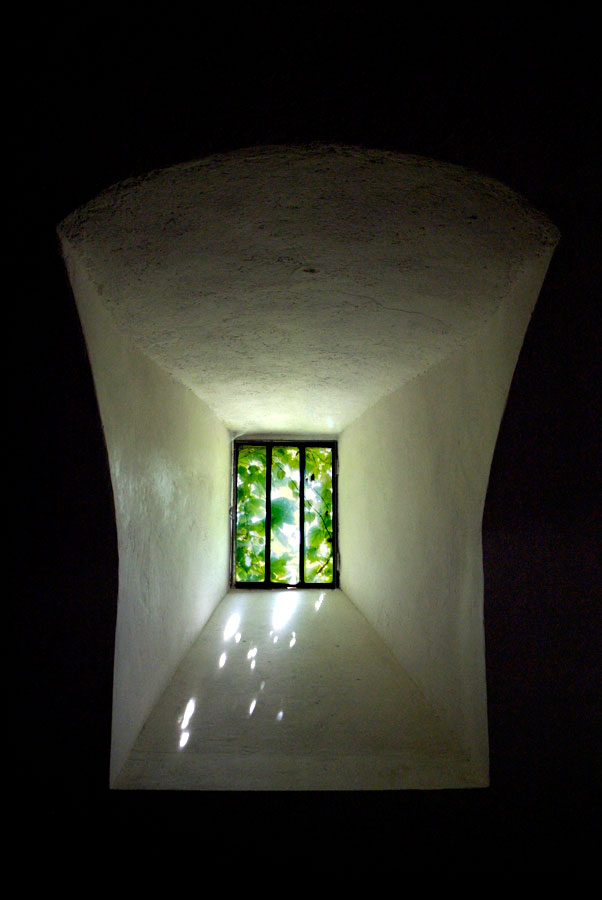 |
When the aperture or opening is large the projections are less sharp. Also when there are multiple openings the rays over lap.
In this image of the light coming through the foliage cover across the window of the Chateau creates a pattern in the series of light patches. However, when I looked closer on the left hand side of the window recess I could see the diffused reference of the scene outside - the blue of the sky outside, through the leaves of the plants across the window. |
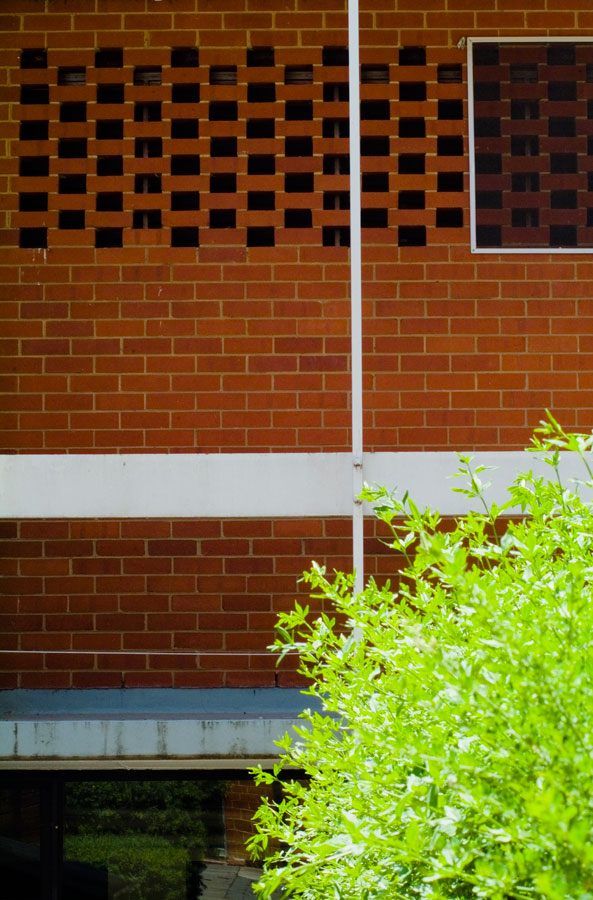 |
In this exterior wall, each of the openings between the bricks acts like a camera and projects an image into the interior of the building. |
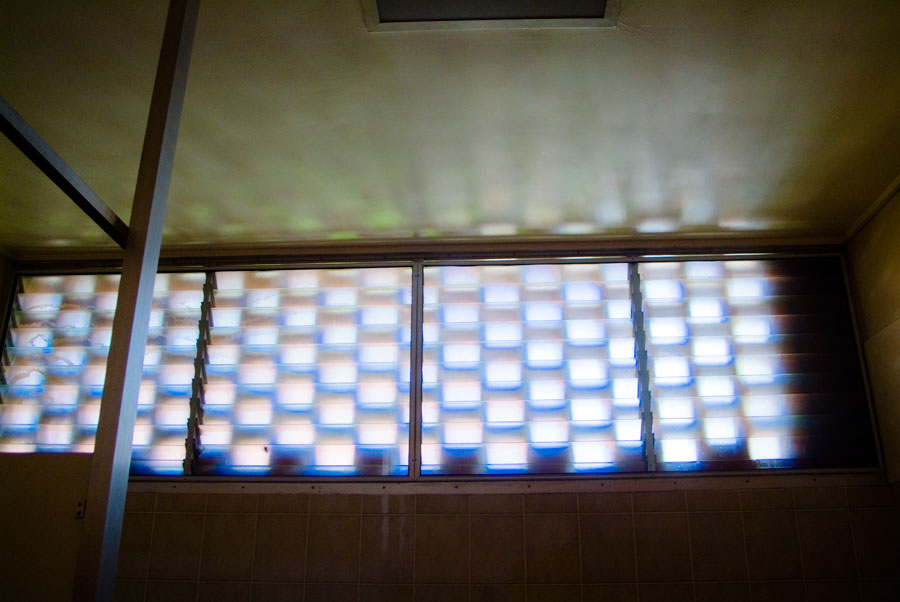 |
Although there is a piece of frosted glass across the windows diffusing the light, the projections can be clearly seen on the ceiling. Notice the green patches on the left, trees and grass, red in the centre, a brick building, aqnd blue on the right a clear area of sky. |
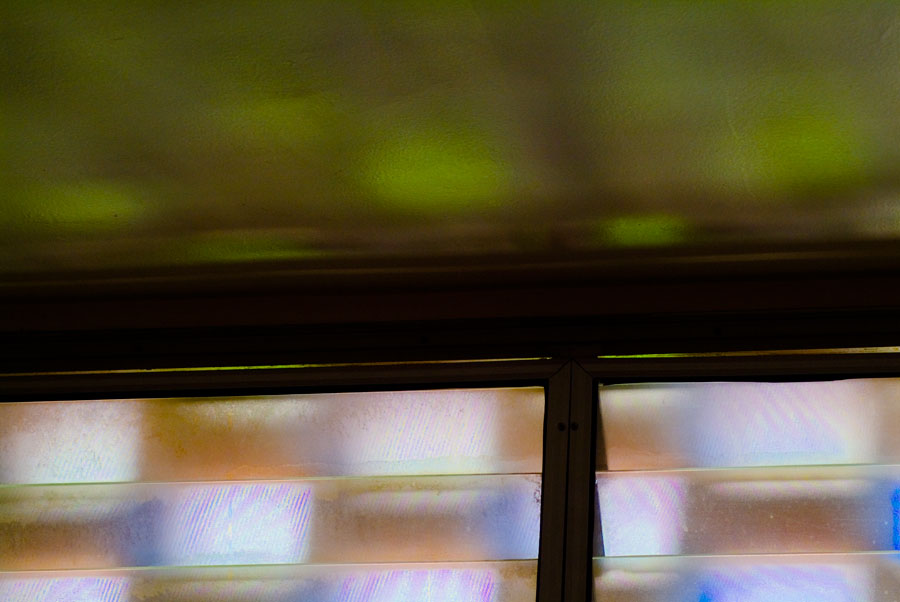 |
Here is a detail of the projections fom the left side of the image above. |
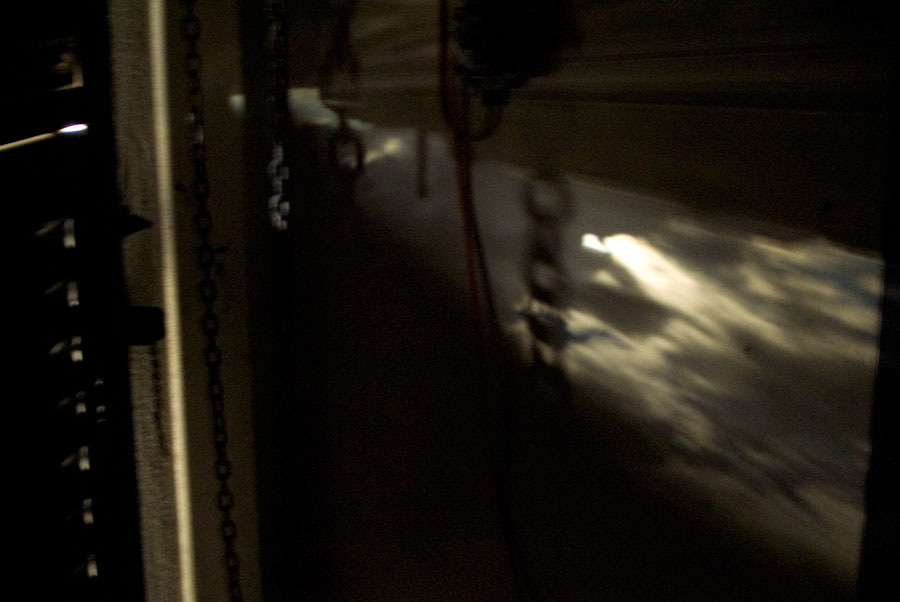 |
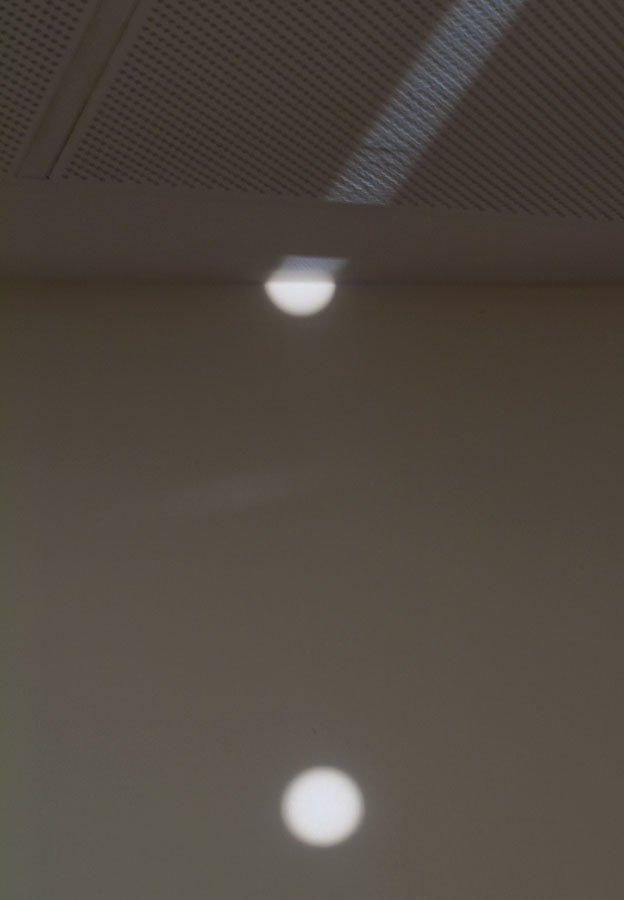
This is a photograph of an incidental pinhole camera image I found in one of the exhibition spaces at the Sydney Biennial July 2008. It was form from a small opening in a roller door projecting across a wall. As the image from an aperture is vertically and laterally reversed, (upside down and back to front) you will notice the image is upside down. We see the blue sky and clouds on the right of the image. This is also larger on the right because of the perspective.
There were 2 chains across where the image was projected, which created corresponding shadow images on the wall. So in a sense the projection became both a pinhole image and a photogram.
|
 |
|
 |
|
 |
|
 |
|
|
Sept 2008 -
Waiting for the light-
So many people mentioned to me a strong spiritual connection from the rays of light in the Carbon Obscura work -
It kept reoccurring - several people went there to meditate - many experienced an uplifting - one even had an epiphany. While daylight is everywhere - it surrounds us, the fine threads of light in the darkened space amplified the effect. Shutting off the light in the foggy atmosphere produced a contradiction that made visible the normally imperceptible.
In thinking about the Carbon Obscura work further - I found it interesting how in normal life there is so much "light" about us that often we might not "see" with a clear vision. Because we drift along, we can be fooled into the belief that we have a clear goal.
Yet in times of difficulty, deepest darkness and the verge of despair, when things seem impossible, we might find a single opening that points the way - a pinhole that projects a clear and sharp vision in a dark space like a camera to another world beyond the darkness. Things can fall into focus in a way we had not perceived before, and when it happens, we are challenged to find the inner conviction to explore it. The darkest hour is just before the dawn when we wait for the first glimmer of light.
Light is like water, darkness a sealed vessel! Like a small opening that is enough for water to leak into the vessel and eventually sink it, light also seeks an opening in the black membrane - an aperture to penetrate the vessel of darkness. On the other hand darkness exerts no such action against light: rather it stands against it as a powerful wall. But darkness is a force that can be over come by even the smallest of openings where light flows through the opening.
|
Early Observations and Experiments
The basic optical principles of the pinhole are commented on in Chinese texts from the fifth century BC. Chinese writers had discovered by experiments that light travels in straight lines. The philosopher Mo Ti (later Mo Tsu) was the first – to our knowledge – to record the formation of an inverted image with a pinhole or screen. Mo Ti was aware that objects reflect light in all directions, and that rays from the top of an object, when passing through a hole, will produce the lower part of an image (Hammond 1981:1). According to Hammond, there is no further reference to the camera obscura in Chinese texts until the ninth century AD, when Tuan Chheng Shih refers to an image in a pagoda. Shen Kua later corrected his explanation of the image. Yu Chao-Lung in the tenth century used model pagodas to make pinhole images on a screen. However, no geometric theory on image formation resulted from these experiments and observations (Hammond 1981:2).
|

The philosopher Mo Ti (later Mo Tsu) |
In the western hemisphere Aristotle (fourth century BC) comments on pinhole image formation in his work Problems. In Book XV, 6, he asks: "Why is it that when the sun passes through quadri-laterals, as for instance in wickerwork, it does not produce a figure rectangular in shape but circular? [...]" In Book XV, 11, he asks further: "Why is it that an eclipse of the sun, if one looks at it through a sieve or through leaves, such as a plane-tree or other broadleaved tree, or if one joins the fingers of one hand over the fingers of the other, the rays are crescent-shaped where they reach the earth? Is it for the same reason as that when light shines through a rectangular peep-hole, it appears circular in the form of a cone? [...]" (Aristotle 1936:333,341). Aristotle found no satisfactory explanation to his observation; the problem remained unresolved until the 16th century (Hammond 1981:5).
The Arabian physicist and mathematician Ibn al-Haytham, also known as Alhazen, experimented with image formation in the tenth century AD. He arranged three candles in a row and put a screen with a small hole between the candles and the wall. He noted that images were formed only by means of small holes and that the candle to the right made an image to the left on the wall. From his observations he deduced the linearity of light. (Hammond 1981:5).
In the following centuries the pinhole technique was used by optical scientists in various experiments to study sunlight projected from a small aperture.
I was attarcted to this image of Aristotle with bhis hand through the aperture of the window - titled the fall of Aristotle |
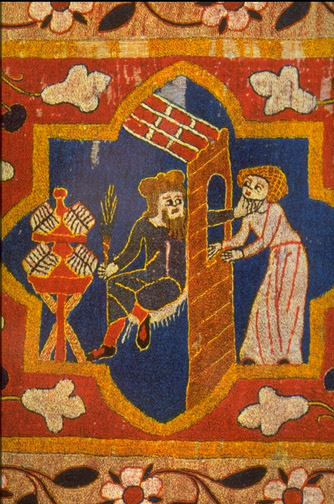
Aristotle's Fall -
tapestry, Augustiner Museum -
Freiburg im Breisgau, Germany
|
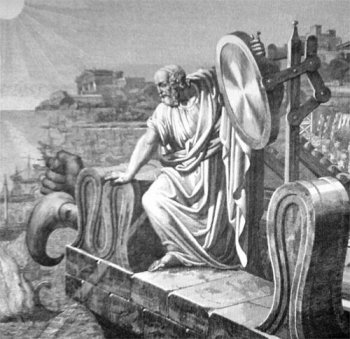
In this image Archimedies is with his burning mirror -
According to Plutarch, Archimedes reflected the Sun's rays onto the Roman galleys and set them alight. Such a story, true or not, was too good for the medieval chroniclers over a thousand years later to resist. Like the tabloid journalists of their day, they embellished the tale with details of their own until history and legend became hopelessly intertwined. Some of these later writers say that Archimedes used the polished round shields of the Greek troops to concentrate the sunlight, while others insist that he focused the rays with a giant single mirror. Joannes Zonaras, a Byzantine historian of the twelfth century, wrote:
At last, in an incredible manner, he burned up the whole Roman fleet. For by tilting a kind of mirror he ignited the air from the beam and kindled a great flame, the whole of which he directed at the ships at anchor in the path of the fire, until he consumed them all.
Archimedes 287?bc 212 first noted aspects of the pigmentation change in plant tissue due to exposure to sunlight and since then photosynthesis has been central to much speculative and scientific investigation. |
|
Uwe Bergmann explains his take on science with an old joke:
A guy comes home one night, really drunk, only to discover he’s lost his house key. He looks for it in the small circle of light surrounding a lamppost. A passerby asks him, “Do you really think you left your key there?” “I don’t know,” the drunk replies, “but it’s the only place with light.”
|